
25 December Christmas Day ,,
Christmas Day, observed every year on 25 December, is far more than just a holiday filled with lights, gifts, and decorations. It is a festival that carries spiritual depth, historical layers, emotional values, and cultural richness. For millions across the world, Christmas is a time of joy, peace, forgiveness, and togetherness. But beyond the celebrations lies a powerful story — the story of the birth of Jesus Christ, a figure who transformed the world with his teachings of compassion, humility, and unconditional love.
Although many people enjoy the festival without necessarily following Christianity, Christmas has grown into a global cultural celebration, touching hearts across all religions and nations. To truly appreciate Christmas, one must understand why it is celebrated, how it began, and what makes 25 December so important.
This in-depth article explores everything:
✔ Why Christmas is celebrated
✔ Why 25 December was chosen
✔ Detailed history from ancient times to modern-day celebrations
✔ Spiritual and cultural significance
✔ Global traditions and their origins
✔ How Christmas evolved across centuries
Let’s explore each concept in detail — slowly, clearly, and beautifully.
🌟 What Is Christmas Day? (Detailed Explanation)
Christmas Day marks the birth of Jesus Christ, who is regarded in Christianity as the Son of God, the Messiah, and the Savior. The story of Jesus’ birth is one of hope and new beginnings. According to the Bible, Jesus was born in Bethlehem, in a humble stable, symbolizing that greatness does not require luxury or status — even the humblest beginning can change the world.
Although the Bible does not record His exact birth date, early Christian leaders chose 25 December for symbolic and practical reasons (explained later in detail). Over time, this date became universally accepted.
Today, Christmas Day is celebrated globally through:
- Colorful decorations
- Lighting homes and streets
- Exchanging thoughtful gifts
- Singing Christmas carols
- Spending time with family
- Enjoying delicious meals
- Attending church services
But beyond these celebrations lies a deeper meaning. Christmas represents:
✨ Hope
The birth of Jesus symbolizes the arrival of hope in a troubled world.
✨ New Beginnings
Just as a newborn brings new life, Christmas encourages people to reset, forgive, and grow.
✨ Joy and Celebration
Christmas is filled with festive energy — music, lights, gatherings, and happiness.
✨ Generosity
Acts of giving, charity, and kindness are central to Christmas.
✨ Togetherness
Families unite, differences fade, and people share love and warmth.
Christmas, therefore, is not only a religious festival — it is a human celebration of positivity, kindness, and unity.
🎄 Why is Christmas Celebrated on 25 December? (Complete Deep Explanation)
Many people believe Jesus was actually born in winter — but there is no historical proof of the exact date. So why 25 December?
There are three major reasons, each rooted in ancient culture, symbolism, and church history.
1. The Ancient Roman Festival: Sol Invictus (Deep Insight)
Long before Christianity spread, the Romans celebrated Sol Invictus on 25 December — the Festival of the Unconquered Sun.
The winter solstice had just passed. Days were short, darkness was long — but from 25 December, sunlight slowly began to increase again. This was celebrated as the rebirth of the sun.
When Christianity emerged in the Roman Empire:
- Pagan festivals were extremely popular
- Early Christians wanted people to adopt Christianity easily
- So they aligned Christian celebrations with existing Roman festivals
Thus, 25 December was chosen to celebrate the birth of Jesus, so that:
- Romans could transition from Sun worship to Jesus worship
- The new Christian festival replaced the old pagan one
- People accepted the date naturally, as the celebration already existed
This strategic decision helped Christianity grow rapidly.
2. Winter Solstice: Symbolism of Light vs Darkness (Full Meaning)
From 21 to 25 December, the winter solstice marks the darkest days of the year.
Ancient cultures believed this moment represented:
- The victory of light over darkness
- The return of hope
- A fresh start
- Nature being reborn
Jesus Christ is often called:
- “The Light of the World”
- “The Hope of Humanity”
- “The Savior who removes darkness”
So celebrating His birth when darkness begins to recede was symbolically perfect.
The message was clear:
As sunlight returns to the world, Jesus brings spiritual light to humanity.
3. Declared by the Early Church (Historical Detail)
By the 4th century, church leaders officially declared 25 December as Christmas Day.
This decision came during the time of:
- Emperor Constantine
- Growing popularity of Christianity
- Structured organization of the Church
Once adopted by the Roman Empire, the date spread across Europe and eventually the entire world.
Thus, 25 December was chosen for both symbolic and strategic reasons, and today it is globally recognized.
🕊️ History of Christmas (Full Expanded Story)
Christmas has a 2,000-year-long history with many transformations.
Let’s break it into clear phases.
1. Birth of Jesus Christ (Historical & Religious Context)
Jesus was born during a period of political chaos. According to the Bible:
- Joseph and Mary traveled to Bethlehem due to a census
- All inns were full, so Mary gave birth in a stable
- Angels informed shepherds of His birth
- Three wise men followed a bright star to find Jesus
- They brought symbolic gifts:
- Gold (kinghood)
- Frankincense (divinity)
- Myrrh (sacrifice)
This moment — the Nativity — is the foundation of Christmas.
2. Early Christians Didn’t Celebrate Christmas
For the first 200 years:
- Christians focused more on Jesus’ teachings
- Easter (Resurrection) was more important
- Birthdays were not commonly celebrated by religious groups
Christmas celebrations began only after Christianity spread widely.
3. First Official Christmas — 336 A.D. (Roman Empire)
The first documented Christmas was celebrated in Rome in 336 A.D.
This marked the beginning of Christmas as a recognized festival.
Christians started celebrating with:
- Prayers
- Simple gatherings
- Meals
- Hymns
Over time, it grew into a major event.
4. Middle Ages (5th–15th Century): Traditions Expand
During this era, Christmas became extremely festive in Europe.
Traditions introduced:
- Carol singing
- Decorating homes with holly, ivy, and candles
- Feasts and community dinners
- Nativity plays
- Gift-giving between families
Christmas slowly became a celebration of joy and community.
5. Modern Christmas (1800s onward): The Christmas We Know Today
From the 19th century, Christmas took its modern form:
🌲 Christmas Trees
Popularized in Germany, later spread to America and the world.
🎅 Santa Claus
Based on Saint Nicholas, a generous bishop known for helping the poor.
💌 Greeting Cards
Began in the 1840s and became a global trend.
🎁 Gift-Giving
Became central, especially for children.
✨ Lights and Decorations
Electric lights transformed Christmas into a glowing holiday.
Today, Christmas is celebrated in unique cultural styles across Asia, Europe, Africa, the Americas, and Australia.
✨ Significance of Christmas Day (Deep Explanation)
Christmas holds enormous value — not only spiritually, but emotionally and socially.
1. Spiritual Meaning
Christmas represents:
- God’s love for humanity
- The beginning of Jesus’ mission
- Hope for a better world
- Light overcoming darkness
- New life and forgiveness
For Christians, it is the most emotional celebration of the year.
2. Celebration of Love and Generosity
Christmas encourages:
- Giving without expecting in return
- Helping strangers and the poor
- Sharing meals
- Supporting charities
- Donating clothes, food, and money
These acts reflect the true spirit of Christmas.
3. Family Bonding and Happiness
People travel long distances to be with family.
Activities include:
- Decorating together
- Preparing special meals
- Exchanging emotional gifts
- Watching Christmas movies
- Singing songs and praying together
It helps strengthen family relationships.
4. Cultural and Global Significance
Because of its universal themes — peace, love, joy — Christmas is celebrated across religions.
It symbolizes:
- Unity
- Human connection
- Positivity
- Community values
🎁 Popular Christmas Traditions (Detailed Explanations)
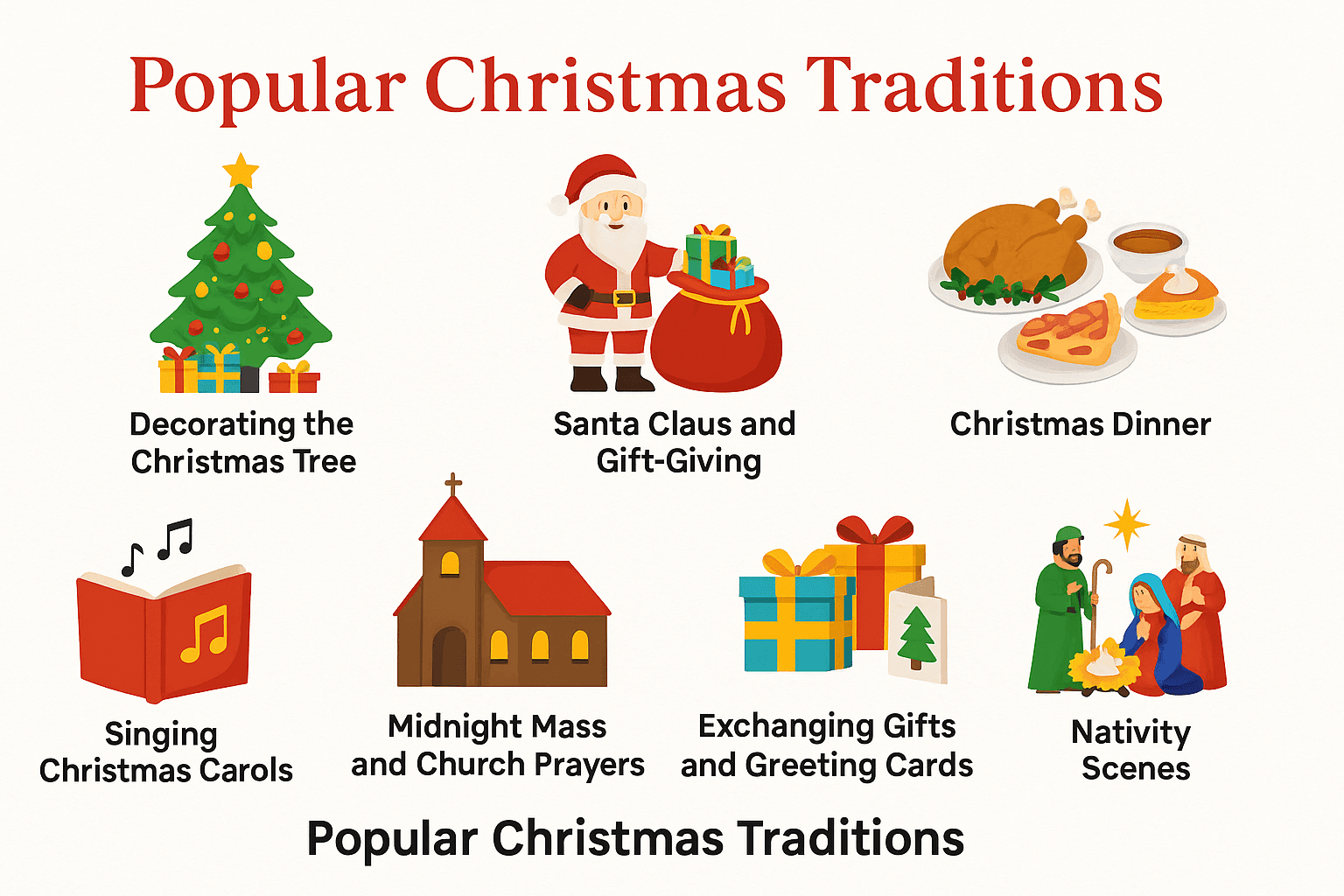
1. Decorating the Christmas Tree
This tradition began in Germany.
People decorate trees with:
- Stars (symbol of the Star of Bethlehem)
- Lights (symbol of Jesus as light)
- Ornaments, bells, ribbons
- Gifts placed under the tree
It brings joy and warmth to homes.
2. Santa Claus and Gift-Giving
Santa is inspired by Saint Nicholas, a kind bishop known for secret gift-giving.
Modern Santa traditions include:
- Red suit
- Reindeer sleigh
- Gifts for children
- Rewards for good behavior
This tradition encourages kindness and good deeds.
3. Christmas Dinner
Families prepare large meals:
- Roasted turkey or chicken
- Mashed potatoes
- Cakes, puddings, pies
- Hot chocolate
- Special desserts
Food brings people together emotionally.
4. Midnight Mass
On Christmas Eve (24 December), churches hold special services:
- Singing hymns
- Candle lighting
- Reading the Nativity story
- Prayers for peace
This connects people to the spiritual meaning of Christmas.
5. Exchanging Gifts
Gifting represents:
- Love
- Appreciation
- Care
People spend weeks planning and selecting gifts.
6. Christmas Carols
Carols create festive spirit:
- “Jingle Bells”
- “Silent Night”
- “O Holy Night”
They are sung at homes, schools, and churches.
🎊 How Christmas Is Celebrated Today
In the modern world, Christmas includes:
- Online shopping
- Social media greetings
- Christmas photoshoots
- School events and plays
- Charity drives
- Community events
- City decorations and festivals
Christmas has beautifully blended tradition with modern lifestyle.
🎉 Interesting Facts About Christmas
- Celebrated in over 160 countries
- “Xmas” isn’t disrespectful — “X” means Christ in Greek
- Santa Claus was made famous by Coca-Cola advertisements
- Billions of gifts are exchanged every year
- Christmas is the world’s biggest holiday season
🧡 Conclusion
Christmas Day on 25 December is far more than a festival of sparkling lights, beautifully wrapped gifts, and delicious feasts. Behind all the decorations and celebrations lies a powerful message that has touched hearts for centuries. Christmas is a reminder of the values that make life meaningful — the warmth of love, the comfort of hope, the harmony of peace, the beauty of generosity, and the joy of true togetherness.
It is a moment when families reconnect, relationships heal, and communities come closer. Christmas encourages us to pause, reflect, and appreciate everything we often take for granted — our loved ones, our blessings, and the opportunities to help others. From its ancient beginnings to today’s global celebrations, Christmas has evolved, yet its core message remains unchanged.
Whether celebrated spiritually or culturally, Christmas inspires millions to be kinder, more forgiving, and more compassionate. It teaches us that even small acts of goodness can light up someone’s world.
As the season of joy arrives each year, Christmas reminds us to spread happiness, share warmth, uplift others, and cherish the people who matter the most.
Christmas is not just a day — it is a feeling, a reminder, and a promise of hope.
If you don’t want to read, you can watch the video by clicking on this Link…
https://youtu.be/3DHbOpS-N0c?si=pTeeQZXJRRE8pJ0S
https://onlinehelpful.com/blog/
Frequently Asked Questions
1. Why is Christmas celebrated on 25 December?
Christmas is celebrated on 25 December to honor the birth of Jesus Christ. Although the exact date of His birth is not recorded in the Bible, early Christians chose this date because it aligned with the Roman festival Sol Invictus and the symbolism of the winter solstice, where light begins to return after the darkest days. This made 25 December a meaningful representation of Jesus as the “Light of the World.”
2. Who is Jesus Christ according to Christianity?
According to Christianity, Jesus Christ is the Son of God and the Savior of humanity. Christians believe He came to earth to teach love, compassion, forgiveness, and righteousness. His life, teachings, miracles, and sacrifice form the foundation of the Christian faith.
3. What is the true meaning of Christmas?
The true meaning of Christmas goes beyond celebrations. It represents:
Love
Hope
Peace
Generosity
Togetherness
It reminds people to be kind, help others, forgive mistakes, and spread joy. Christmas inspires spiritual reflection and encourages positive change in one’s life.
4. Why do we decorate a Christmas tree?
The tradition of decorating a Christmas tree began in Germany. People used evergreen trees as a symbol of eternal life. Over time, the tree became a centerpiece of Christmas décor, decorated with lights, ornaments, stars, and gifts. Today, Christmas trees represent joy, celebration, and the festive spirit.
5. Who is Santa Claus and why is he important?
Santa Claus is inspired by Saint Nicholas, a Christian bishop known for his generosity and kindness. Modern Santa is portrayed as a joyful man in a red suit who brings gifts to children on Christmas Eve. He symbolizes generosity, happiness, and the magic of Christmas for kids.
6. What are the most common Christmas traditions?
Some of the most popular Christmas traditions include:
Decorating the Christmas tree
Exchanging gifts
Attending church services
Singing Christmas carols
Preparing special meals
Setting up Nativity scenes
Visiting family and friends
These traditions vary across cultures but share the same spirit of joy and togetherness.
7. How is Christmas celebrated around the world?
Christmas celebrations differ from country to country. For example:
In the USA and UK, families decorate trees, exchange gifts, and enjoy festive dinners.
In Europe, Christmas markets and carol singing are very popular.
In the Philippines, Christmas celebrations start as early as September.
In India, communities attend church services, share sweets, and decorate homes with stars and lights.
8. What is the significance of gift-giving on Christmas?
Gift-giving represents the gifts brought by the Three Wise Men for baby Jesus — gold, frankincense, and myrrh. It also symbolizes God’s gift of Jesus to humanity. Today, exchanging gifts reflects love, appreciation, and the joy of sharing with others.
9. Why is Christmas considered a festival of joy and happiness?
Christmas brings people together, strengthens relationships, and encourages acts of kindness. Homes are decorated beautifully, families gather for meals, communities share joy, and children look forward to Santa. This collective atmosphere of love and celebration makes Christmas a festival of joy.
10. Is Christmas only a religious festival?
No. While Christmas holds deep religious meaning for Christians, it is also celebrated as a global cultural festival. People from all backgrounds enjoy its decorations, music, lights, and traditions. The universal themes of love, peace, and generosity make Christmas meaningful for everyone.