
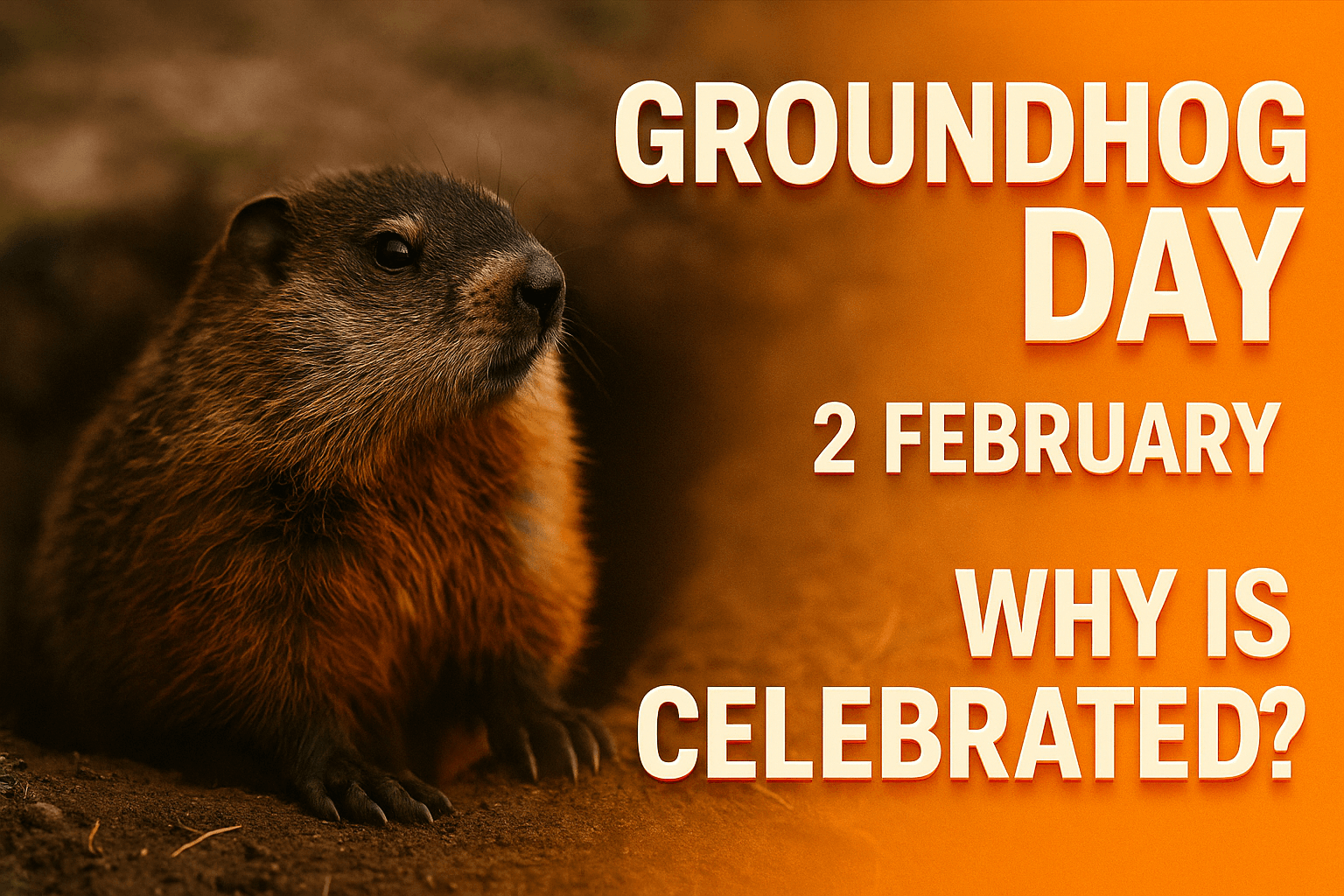
Groundhog Day is one of the most fascinating and widely celebrated traditions in the United States and Canada. Every year on 2 February, millions of people eagerly wait to see whether a small, furry animal called the groundhog will predict an early spring or six more weeks of winter. Although the event may seem simple and entertaining on the surface, the story behind Groundhog Day is filled with rich history, cultural beliefs, and centuries-old traditions.
This article explains Groundhog Day in a clear, detailed, and engaging way—perfect for readers who want to understand the meaning, origins, celebrations, and accuracy of this unusual holiday.
What Exactly Is Groundhog Day?
Groundhog Day is a traditional event where a groundhog emerges from its burrow early in the morning on 2 February. The way it reacts to the weather is believed to predict the arrival of spring.
According to the popular belief:
👉 If the groundhog sees its shadow (meaning the weather is sunny),
people say winter will continue for six more weeks.
👉 If the groundhog does NOT see its shadow (meaning it’s cloudy),
people believe spring will arrive early.
Although this prediction isn’t scientific, it has become a beloved cultural celebration that brings joy and excitement every year.
Why Is Groundhog Day Celebrated on 2 February?
The date, 2 February, has deep historical significance. It is not just a random day chosen by Americans; it is connected to ancient seasonal traditions and old European beliefs.
✔ Midpoint between Winter and Spring
2 February falls exactly halfway between the winter solstice (the shortest day of the year) and the spring equinox (when day and night become equal). Ancient people believed this midpoint revealed important information about upcoming weather.
✔ Connection to Candlemas Day
Groundhog Day is closely related to Candlemas Day, a Christian tradition celebrated in Europe. Candlemas also involved predicting whether winter would continue.
A famous old saying was:
“If Candlemas Day is bright and clear, winter will stay for a longer year.”
German communities believed that animals—especially hedgehogs or badgers—could help predict the weather on Candlemas. When they migrated to North America, they replaced hedgehogs with groundhogs, which were common in the region.
This combination of beliefs eventually formed the Groundhog Day we know today.
History of Groundhog Day
Groundhog Day became part of American culture more than a century ago. Here is the interesting journey of how it started:
📌 Early 1800s
German immigrants brought their Candlemas weather prediction customs to Pennsylvania.
📌 1887
The very first official Groundhog Day celebration took place in Punxsutawney, Pennsylvania. The people of the town declared a groundhog named Punxsutawney Phil as America’s official weather predictor.
📌 1900s–Present
As newspapers, radio, and television grew, Punxsutawney Phil became a national celebrity.
By the late 1900s, thousands of tourists started visiting the town every year.
📌 1993 – The Groundhog Day Movie
The Hollywood movie “Groundhog Day” starring Bill Murray turned the holiday into a global phenomenon. The film not only became a classic but also made the event more popular across the world.
Who Is Punxsutawney Phil?
Punxsutawney Phil is the most famous groundhog in the world. Every year, he appears at Gobbler’s Knob, a hilltop in Pennsylvania, surrounded by crowds, media, and an official group called the Inner Circle.
According to tradition:
- Phil drinks a special “elixir of life” that gives him long life
- He has been predicting the weather since 1887
- The Inner Circle interprets Phil’s prediction in front of thousands of people
- His prediction is broadcast on TV and the internet worldwide
Even though these stories are symbolic, they add charm and fun to the celebration.
How Groundhog Day Is Celebrated Today
Groundhog Day has grown from a small local tradition to a major cultural event.
🎉 Early Morning Gathering
Before sunrise, people gather at Gobbler’s Knob to watch Phil come out of his burrow.
🎶 Music, Performances & Festivities
Local bands, folk performances, dances, and community events continue throughout the day.
📰 Live Broadcast Worldwide
The prediction is broadcast on television and live-streamed online for millions of viewers.
🎭 Family Fun & Activities
Parades, games, food stalls, winter carnivals, and humorous shows keep the holiday entertaining for all ages.
😄 A Day of Joy & Humor
People enjoy the festival with funny posters, costumes, and jokes about the weather.
Meaning Behind the Prediction
Groundhog Day carries symbolic meaning:
🌨️ If the groundhog sees its shadow
People believe winter will stay longer. This reflects the traditional idea that a bright, sunny day in February signals extended cold weather.
🌱 If the groundhog doesn’t see its shadow
It means spring will come early, allowing people to hope for warmer days soon.
Although the prediction is not taken seriously as a scientific forecast, it is a joyful, light-hearted tradition that brings communities together.
Is the Groundhog’s Prediction Accurate?
One of the most common questions people ask is:
“Does the groundhog actually predict the weather correctly?”
Scientific studies say:
✔ Accuracy is around 35–40%
This means the groundhog is wrong more often than right.
Weather prediction is complex and cannot be determined by an animal’s reaction to sunlight. However, people love Groundhog Day because:
- It’s fun
- It’s traditional
- It brings people together
- It celebrates culture and folklore
So, the accuracy doesn’t really matter—what matters is the joy it brings.
Interesting Facts About Groundhog Day
Here are some fun and surprising facts that make Groundhog Day even more fascinating:
🐾 1. Punxsutawney Phil is considered over 100 years old
His long life is part of the folklore.
🎬 2. The 1993 Groundhog Day movie boosted worldwide popularity
🥳 3. Over 10,000 people gather at Gobbler’s Knob each year
📺 4. Groundhog Day is broadcast globally
🦔 5. The tradition started with European hedgehogs
❄️ 6. The Inner Circle wears top hats and tuxedos
🌎 7. Several towns have their own “famous groundhogs”,
including:
- Staten Island Chuck
- Wiarton Willie
- Shubenacadie Sam
Why Groundhog Day Still Matters Today
Even though modern weather forecasting technology exists, Groundhog Day continues to thrive because:
- It represents tradition and culture
- It adds fun and excitement to winter
- It strengthens community spirit
- It symbolizes hope for spring
- It gives people something positive and enjoyable to look forward to
In a fast-paced world, such simple traditions remind us to pause, smile, and celebrate something joyful.
Conclusion
Groundhog Day, celebrated every year on 2 February, is much more than a weather prediction tradition—it is a cultural treasure filled with history, folklore, and fun. Whether the groundhog sees its shadow or not, the excitement of watching the prediction, the crowds, the celebrations, and the happiness of the moment make this day truly special.
The holiday carries forward beliefs from ancient Europe, traditions brought by immigrants, and the spirit of modern community celebrations. Even though the prediction isn’t scientifically accurate, the charm and enthusiasm of Groundhog Day keep it alive year after year.
It reminds us that sometimes, even the simplest traditions can bring the greatest joy.
If you don’t want to read, you can watch the video by clicking on this Link…
https://youtu.be/wTvxtFb4BCc?si=yscQ_dCN7fXYPr_2
https://onlinehelpful.com/blog/
Frequently Asked Questions
1. What is Groundhog Day?
Groundhog Day is a tradition celebrated on 2 February in the United States and Canada, where a groundhog predicts whether winter will continue or spring will arrive early based on whether it sees its shadow.
2. Why is Groundhog Day celebrated on 2 February?
Groundhog Day is celebrated on 2 February because it is the midpoint between the winter solstice and the spring equinox. The date comes from ancient European traditions linked to Candlemas Day and weather prediction beliefs.
3. What does it mean if the groundhog sees its shadow?
If the groundhog sees its shadow, it is believed that winter will last for six more weeks. This happens when the weather is sunny on 2 February.
4. What does it mean if the groundhog does not see its shadow?
If the groundhog does not see its shadow due to cloudy weather, it is believed that spring will arrive early.
5. Who is Punxsutawney Phil?
Punxsutawney Phil is the most famous groundhog associated with Groundhog Day. He appears each year at Gobbler’s Knob in Pennsylvania to make the official weather prediction.
6. Is the groundhog’s weather prediction accurate?
Scientific studies show the groundhog’s weather predictions are only about 35–40% accurate. Groundhog Day is primarily a cultural tradition, not a scientific forecast.
7. Where is the biggest Groundhog Day celebration held?
The largest and most famous Groundhog Day celebration takes place in Punxsutawney, Pennsylvania, where thousands of people gather each year.
8. What is the origin of Groundhog Day?
Groundhog Day originated from ancient European Candlemas traditions. German immigrants brought the custom to America, where it evolved into the modern groundhog-based prediction festival.
9. Do other animals besides groundhogs predict the weather?
Yes. Several towns have their own weather-predicting animals, including Staten Island Chuck, Wiarton Willie, and Shubenacadie Sam. These traditions vary by region.