
How Many Days Are in a Year? The Complete Guide
At first glance, this seems like one of the simplest questions you could ask. Everyone “knows” the answer: 365 days. It’s printed on calendars, built into our planners, and drilled into us from childhood. But the moment you dig a little deeper, the question turns out to be far more interesting than it appears. Is it exactly 365 days? What about leap years? Why do we even have leap years? And does “a year” mean the same thing in astronomy, in different calendar systems, and in everyday life?
In this post, we’ll unpack the surprisingly rich answer to a question most people never think twice about.
The Short Answer
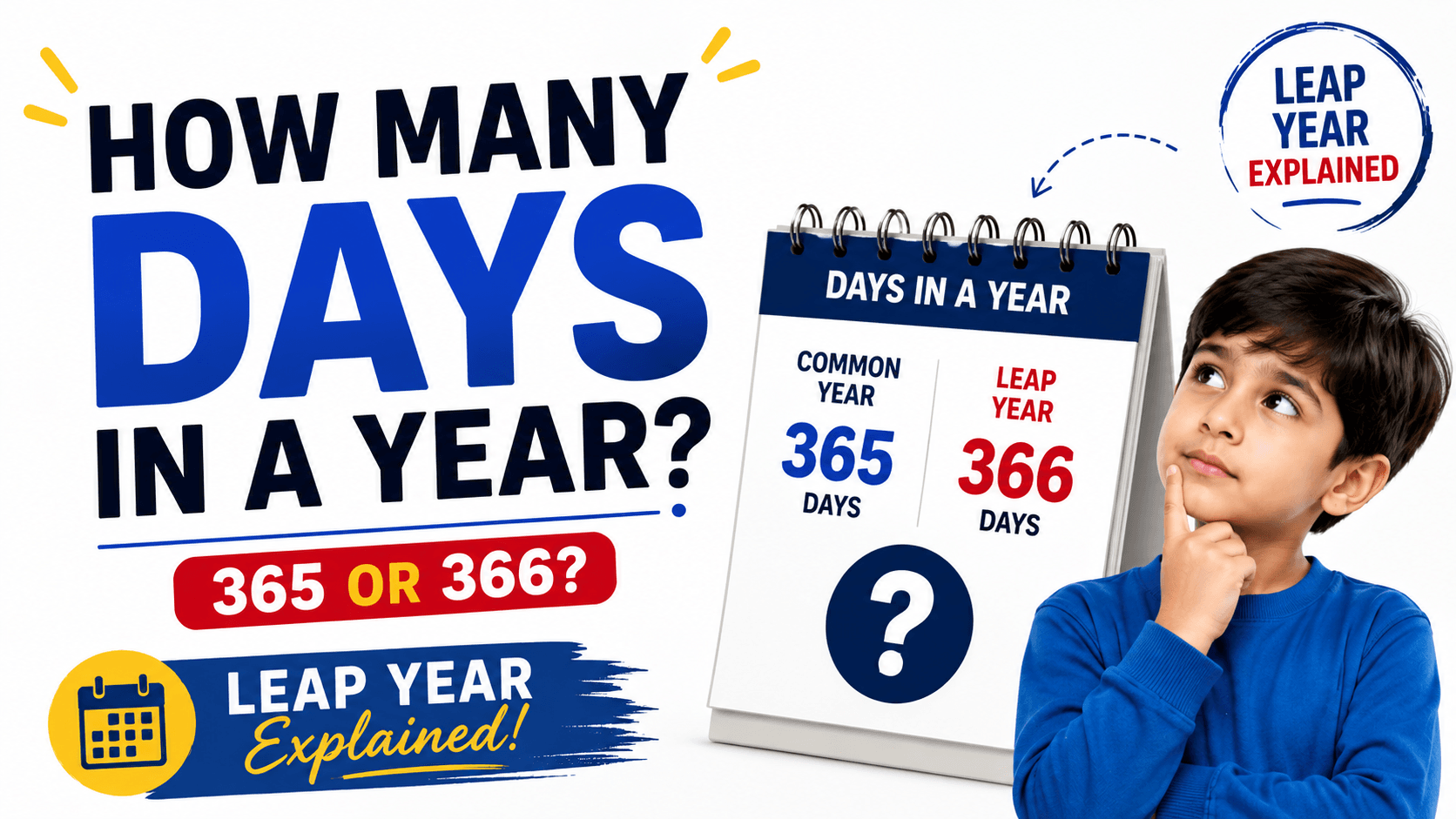
For most practical purposes, a year has 365 days. This is the number of days in a standard (non-leap) calendar year, based on the Gregorian calendar, which is the calendar used by most of the world today.
However, every four years, we add one extra day — February 29 — making that year 366 days long. This is called a leap year, and it exists to keep our calendar synchronized with the Earth’s actual orbit around the Sun.
So technically, the answer depends on which year you’re talking about. But the deeper answer lies in astronomy.
Why Isn’t a Year Exactly 365 Days?
To understand why we need leap years at all, we have to look at what a “year” actually measures. A year is meant to represent the time it takes for the Earth to complete one full orbit around the Sun. Astronomers call this the solar year or tropical year.
The problem is that this orbital period doesn’t divide evenly into whole days. The Earth doesn’t complete its orbit in exactly 365 days — it takes approximately 365.2422 days, or about 365 days, 5 hours, 48 minutes, and 45 seconds.
That extra roughly quarter-day might seem trivial, but over time it adds up. If we simply ignored that fraction and used a fixed 365-day calendar year, the calendar would drift out of sync with the seasons by about one full day every four years. Over centuries, this drift would become severe — eventually pushing what we call “summer” in the calendar into what would actually be winter conditions.
To prevent this drift, ancient astronomers and calendar-makers introduced the concept of adding an extra day periodically. This is the origin of the leap year.
The History of the Leap Year
The Julian Calendar
The idea of adding an extra day every four years dates back to Julius Caesar, who introduced the Julian calendar in 45 BCE. Working with the astronomer Sosigenes of Alexandria, Caesar established a system where every fourth year would have 366 days instead of 365, with the extra day added to February.
This was a huge improvement over the previous Roman calendar, which had become wildly inaccurate due to political manipulation and irregular month lengths. The Julian calendar assumed the year was exactly 365.25 days long, which is very close to the true figure but not quite perfect.
The Problem With the Julian Calendar
Here’s the catch: the actual solar year is about 365.2422 days, not 365.25 days. That’s a difference of roughly 0.0078 days per year — around 11 minutes. It sounds negligible, but over centuries it compounds. By the 16th century, the Julian calendar had drifted about 10 days out of alignment with the seasons and astronomical events like the spring equinox.
This was a real problem for the Catholic Church, which relied on the date of the spring equinox to calculate Easter. The growing misalignment threatened to push religious observances out of sync with their intended astronomical markers.
The Gregorian Reform
In 1582, Pope Gregory XIII introduced a reform to fix this drift. The new system, known as the Gregorian calendar, refined the leap year rule to make the average calendar year more precisely match the true solar year.
The Gregorian rule works like this:
- A year is a leap year if it is divisible by 4.
- However, if the year is divisible by 100, it is NOT a leap year…
- Unless it’s divisible by 400, in which case it is a leap year.
Let’s see this in action:
- 2000 was divisible by 4, by 100, and by 400 → it WAS a leap year.
- 1900 was divisible by 4 and by 100, but not by 400 → it was NOT a leap year.
- 2024 is divisible by 4 but not by 100 → it IS a leap year.
- 2100 will be divisible by 4 and by 100, but not by 400 → it will NOT be a leap year.
This clever adjustment removes three leap years every 400 years compared to the Julian system, bringing the average calendar year length to 365.2425 days — remarkably close to the true solar year of 365.2422 days. The remaining discrepancy is so tiny that it only amounts to about one day of drift every 3,300 years.
Leap Year Frequency: How Common Are They?
Under the Gregorian calendar, leap years occur in roughly 97 out of every 400 years, rather than the 100 you’d get from a simple “every 4 years” rule. This might sound like a small tweak, but it’s precisely what keeps our calendar so accurate over long stretches of time.
To put it another way: about 24.25% of years are leap years, meaning just under a quarter of the years we experience have that extra 366th day.
What About Leap Seconds?
Leap years aren’t the only correction we apply to keep time synchronized with astronomical reality. There’s also the leap second, a much smaller and less well-known adjustment.
The Earth’s rotation on its axis (which determines the length of a day) is not perfectly constant. It’s affected by factors like tidal friction from the Moon, shifts in the Earth’s core, melting ice caps, and even large earthquakes. Because of this, the length of a solar day very gradually changes over time.
To keep atomic clock time (which is extremely precise and doesn’t care about the Earth’s rotation) aligned with solar time (which does), scientists occasionally add a leap second to Coordinated Universal Time (UTC). This has happened periodically since 1972. Interestingly, in recent years, the Earth’s rotation has actually sped up slightly in some periods, leading to discussions about whether a negative leap second might eventually be needed — something that has never happened before.
Leap seconds are a completely separate mechanism from leap years, but they illustrate the same underlying theme: our timekeeping systems require constant small corrections because natural astronomical cycles don’t divide evenly into human-friendly units.
Different Types of “Year”
Interestingly, “a year” isn’t just one single, universally agreed-upon length of time. Depending on context, astronomers and calendar-makers define several different kinds of years:
Tropical Year (Solar Year): Approximately 365.2422 days. This is the time it takes for the Sun to return to the same position in the cycle of seasons — for example, from one spring equinox to the next. This is the year our calendar is designed to approximate, since it governs the seasons we experience.
Sidereal Year: Approximately 365.2564 days. This measures the time for Earth to complete one full orbit relative to the fixed stars, rather than relative to the equinoxes. It’s slightly longer than the tropical year due to the slow wobble of Earth’s axis, known as precession.
Anomalistic Year: Approximately 365.2596 days. This measures the time between successive passages of Earth through perihelion — the point in its orbit closest to the Sun.
Lunar Year: Approximately 354.37 days. This is based on 12 lunar months (the cycle of the Moon’s phases), and it’s shorter than the solar year by about 11 days. The Islamic (Hijri) calendar uses a purely lunar year, which is why Islamic holidays shift earlier by about 11 days each year relative to the Gregorian calendar.
Lunisolar Year: Some calendars, like the Hebrew and Chinese calendars, combine lunar months with periodic adjustments (extra “leap months”) to stay roughly aligned with the solar year. This gives lunisolar calendars a mix of 353–385 days depending on the specific year and calendar system.
Days in a Year Across Different Calendars
It’s worth remembering that the Gregorian calendar, while dominant globally today, is not the only calendar system humans have used or still use.
- Gregorian Calendar: 365 or 366 days, as described above.
- Julian Calendar: Still used by some Orthodox Christian churches for religious purposes; averages 365.25 days per year.
- Islamic (Hijri) Calendar: A purely lunar calendar with 354 or 355 days per year, with no leap-day correction to match the solar year — which is why it drifts through the seasons over a roughly 33-year cycle.
- Hebrew Calendar: A lunisolar calendar that adds a leap month (Adar II) seven times in a 19-year cycle, resulting in years of 353, 354, 355, 383, 384, or 385 days.
- Chinese Calendar: Also lunisolar, with regular years of about 353–355 days and leap years (with an inserted leap month) of about 383–385 days.
- Hindu Calendar: Various regional versions exist, many of which are lunisolar and use similar leap-month adjustments to stay aligned with the solar year.
- Persian (Solar Hijri) Calendar: One of the most astronomically precise calendars in use today, with years of 365 or 366 days determined by direct astronomical observation of the vernal equinox rather than a fixed mathematical rule.
This diversity shows that “how many days in a year” really depends on which culture’s or civilization’s answer you’re looking for — even though nearly all of these systems are ultimately trying to track the same underlying astronomical reality.
Fun Facts and Curiosities About the Year
A “Leap Day” baby’s birthday dilemma: People born on February 29 (sometimes called “leaplings” or “leapers”) technically only have a birthday on the calendar once every four years. Most choose to celebrate on either February 28 or March 1 in common years.
Not all 366-day years are Gregorian leap years: In lunisolar calendars, a “leap year” with an extra month can be considerably longer than 366 days — sometimes reaching 383 to 385 days, since an entire extra month is inserted rather than a single day.
Business and financial years often round to 360: Some financial and accounting systems historically used a simplified 360-day “year” (12 months of 30 days each) purely for ease of calculating interest and other figures — a convention with roots going back to ancient Babylonian mathematics, which favored the base-60 number system.
The Earth is very gradually slowing down: Due to tidal friction primarily caused by the Moon, Earth’s rotation is slowly decelerating over geological timescales. This means that in the distant past, days were shorter, and a “year” (which is fixed by Earth’s orbit, not its rotation) contained more days. Hundreds of millions of years ago, a year may have had over 400 days, each one shorter than 24 hours.
Leap years and the workplace: Leap years occasionally spark debates in workplaces about whether salaried employees are effectively working an extra unpaid day, since February 29 adds a work day without necessarily adding extra compensation for those on fixed annual salaries.
Quick Reference: Days in a Year at a Glance
| Type | Approximate Length |
|---|---|
| Common (non-leap) Gregorian year | 365 days |
| Leap Gregorian year | 366 days |
| Average Gregorian year (over 400 years) | 365.2425 days |
| Tropical (solar) year | 365.2422 days |
| Sidereal year | 365.2564 days |
| Lunar year (12 lunar months) | ~354.37 days |
| Julian calendar average year | 365.25 days |
Conclusion
So, how many days are in a year? The honest answer is: it depends on what kind of year you mean and which calendar system you’re using. For the calendar most of us live by day to day — the Gregorian calendar — the answer is 365 days in a common year and 366 days in a leap year, occurring according to a precise mathematical rule designed to keep our calendar closely aligned with Earth’s actual orbit around the Sun.
But zoom out, and you discover an entire universe of nuance: astronomical years that don’t divide evenly, ancient calendar reforms driven by religious and political necessity, lunar and lunisolar calendars used by billions of people worldwide, and even the slow, almost imperceptible drift of Earth’s rotation over deep time.
What seems like a simple, settled fact of everyday life turns out to be the product of thousands of years of astronomical observation, mathematical refinement, and cultural negotiation — all in the effort to answer one deceptively simple question: how long does it really take for our planet to go around the Sun?
➤ Click here to discover the history, significance, celebrations, and fascinating facts about important national and international days from around the world.
https://onlinehelpful.com/category/important-days/
➤ Would rather watch than read? Click the link below to see the full video guide.
https://youtu.be/XcMzyC2FITo?si=RsDv88deFIgCL5H3
Frequently Asked Questions
A standard Gregorian calendar year has 365 days, while a leap year has 366 days.
A leap year adds February 29 to keep the calendar synchronized with Earth’s orbit around the Sun.
A year is generally a leap year if it is divisible by 4. Years divisible by 100 are not leap years unless they are also divisible by 400.
Earth takes approximately 365.2422 days to complete its orbit around the Sun, so an extra day is periodically needed.
Under the Gregorian calendar, there are 97 leap years in every 400-year cycle.
A leap year adds an extra day to the calendar, while a leap second is a time adjustment used to keep atomic time aligned with Earth’s rotation.
No. Different calendar systems have different year lengths. For example, the Islamic calendar has about 354 or 355 days.