
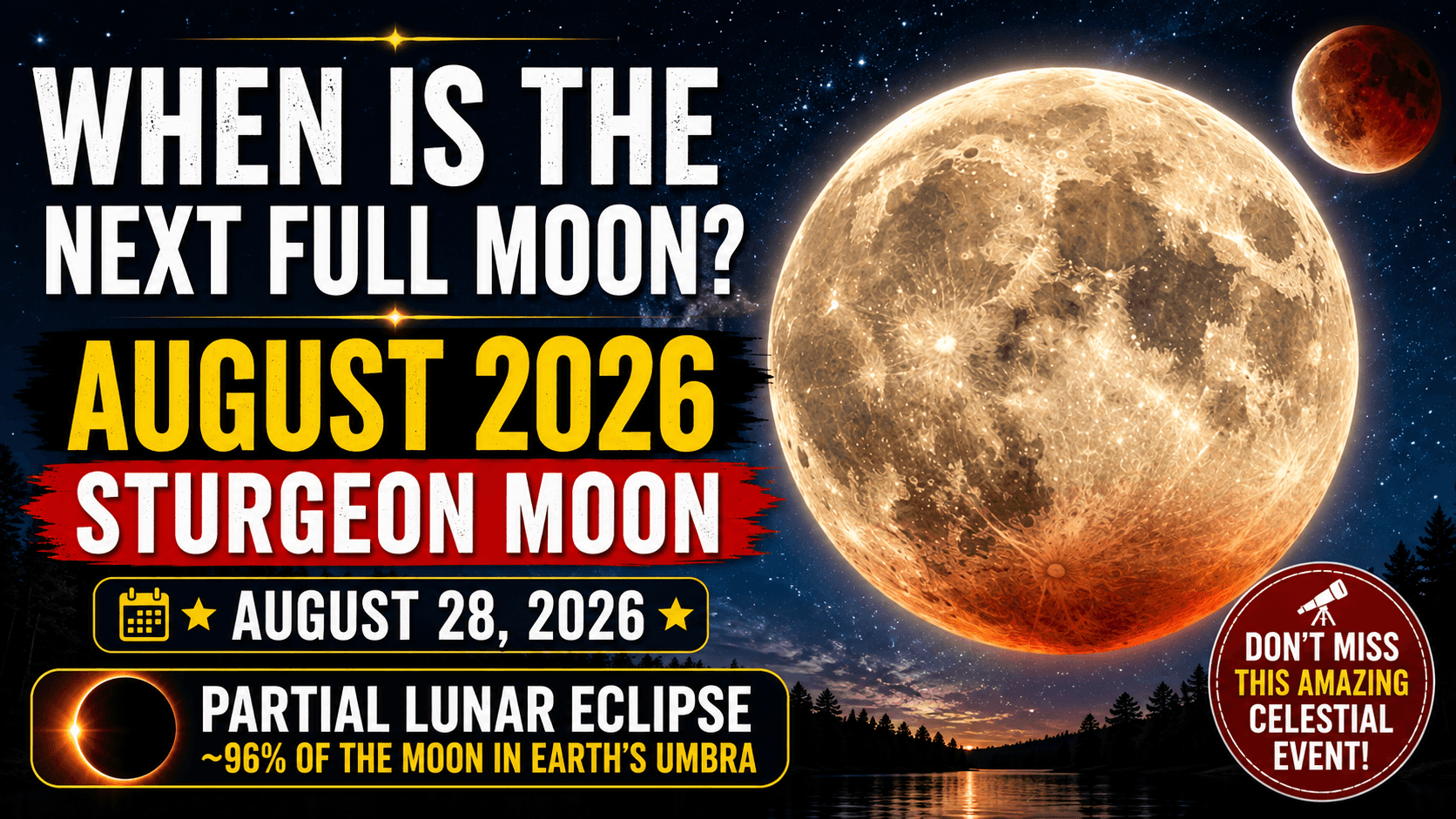
When Is the Next Full Moon? Everything You Need to Know About the August 2026 Sturgeon Moon
There is something universally captivating about a full moon. Long before streetlights and smartphones, our ancestors organized their lives, their calendars, and even their myths around the rhythmic glow of the full moon rising over the horizon. Today, even in our hyper-connected world, people still pause to look up when the moon is full — to snap a photo, to feel a strange sense of calm, or simply to marvel at how something so far away can look so enormous and bright. If you’re wondering “When is the next full moon?”, this guide covers the date, timing, and key details about this month’s full moon.
The Short Answer: The Next Full Moon Is on August 28, 2026
The next full moon will occur on Friday, August 28, 2026, at 12:18 a.m. EDT (04:18 UTC/GMT). This full moon is known as the Sturgeon Moon, and it comes with an extra dose of celestial drama this year: it will be accompanied by a partial lunar eclipse, during which roughly 96% of the moon’s surface will be darkened by Earth’s shadow.
Quick facts about this full moon:
- Date: Friday, August 28, 2026
- Exact peak time: 12:18 a.m. EDT / 04:18 UTC / around 5:18 a.m. in the UK
- Name: Sturgeon Moon
- Special feature: Partial lunar eclipse (~96% of the moon’s surface darkened)
- Visibility window: Appears full to the naked eye for about a day before and after the peak
Because the moon reaches its “exact” full phase at a specific moment in time, the date and time can shift slightly depending on where you live. Regardless of the exact minute, the moon will appear full and bright for about a day before and after this peak, so you don’t need to worry about catching the precise second it happens.
Why Is It Called the “Sturgeon Moon”?
Every full moon throughout the year has a traditional name, and most of these names trace back to Native American, Colonial American, and European folk traditions. They were practical labels, used by farmers, hunters, and fishing communities to track the seasons before printed calendars were widely available.
- The Sturgeon Moon gets its name from the sturgeon fish, a large, ancient species that was traditionally caught in the greatest numbers during late summer in the Great Lakes and other major North American waterways.
- Communities that depended on fishing for food and trade noticed sturgeon were unusually abundant around this time of year, and the name stuck for generations.
- Other names for the August full moon include the Grain Moon, the Green Corn Moon, and the Red Moon (referring to the reddish hue the moon can take on when viewed low on the summer horizon through a hazy atmosphere).
Worth noting: none of these names has any actual effect on how the moon looks or behaves. You will never see a moon that’s literally green or grain-colored just because of its name — any color changes you notice are purely due to atmospheric conditions.
What Makes This Full Moon Special: A Partial Lunar Eclipse
While every full moon is worth a glance skyward, the August 28, 2026 Sturgeon Moon stands out because it coincides with a partial lunar eclipse.
How a lunar eclipse works:
- It happens when the Earth passes directly between the sun and the moon, casting its shadow onto the lunar surface.
- During a partial eclipse, only part of the moon passes through the darkest part of Earth’s shadow (the umbra), while the rest remains illuminated or passes through the lighter outer shadow (the penumbra).
- In this case, around 96% of the moon’s surface is expected to be darkened by Earth’s shadow — just shy of a total eclipse.
- Observers could see the moon take on a dimmed, coppery, or reddish appearance across most of its face, while a thin sliver stays brighter.
- This reddish tint (often called a “Blood Moon” during total eclipses) is caused by sunlight filtering through Earth’s atmosphere and bending around the edges of our planet — the same phenomenon that makes sunsets red.
Because so much of the moon will be covered by shadow, this promises to be one of the most visually striking full moons of the year — well worth setting an alarm for, especially if you have a clear view of the eastern sky after sunset.
How Full Moons Work: A Quick Refresher
To fully appreciate the spectacle, it helps to understand what actually happens during a full moon.
- The moon doesn’t produce its own light — it simply reflects sunlight.
- As the moon orbits Earth roughly every 29.5 days (called the synodic month), the portion of its surface illuminated from our point of view changes, creating the familiar cycle of phases: new moon → waxing crescent → first quarter → waxing gibbous → full moon → waning gibbous → last quarter → waning crescent.
- A full moon occurs when the moon sits on the exact opposite side of Earth from the sun, so the entire face turned toward us is lit up, appearing as a complete, brilliant circle.
- Because the moon and sun are opposite each other during this phase, the full moon rises around sunset and sets around sunrise, staying visible all night.
This opposition also explains why full moons are linked to tides:
- When the sun, Earth, and moon align — which happens during both new moons and full moons — their combined gravitational pull creates a “spring tide” (unusually high highs and low lows).
- This is different from the moderate “neap tides” that occur when the sun and moon are at right angles to each other.
The Full Moon Calendar for the Rest of 2026
If you miss the August Sturgeon Moon, don’t worry — full moons happen roughly every month. And 2026 is a special year: most years have twelve full moons, but roughly every two to three years a year squeezes in a thirteenth. When two full moons occur in the same calendar month, the second one is nicknamed a “Blue Moon.” In 2026, this extra full moon fell in May, giving the year thirteen full moons instead of the usual twelve.
Here’s what’s coming after the Sturgeon Moon:
- September 26, 2026 — Harvest Moon. The full moon closest to the autumnal equinox. Its early evening rising traditionally gave farmers extra light to finish the harvest. It can occasionally fall in October instead, depending on the year.
- October 26, 2026 — Hunter’s Moon. Follows the Harvest Moon; named because once fields were cleared, hunters found it easier to spot animals foraging in the open under its light.
- November — Beaver Moon. Named for when beavers became most active building winter dams, or when trappers set beaver traps before waterways froze.
- December 23, 2026 — Cold Moon. The year’s final full moon, and also the third and final supermoon of 2026 (appearing slightly larger and brighter than average because the moon is closer to Earth at that point in its orbit).
And earlier in the year:
- May 1, 2026 — Flower Moon
- May 31, 2026 — Blue Moon (the extra full moon that pushed 2026’s total to thirteen)
- July 2026 — Buck Moon, named for the time of year male deer begin growing new antlers
Tips for Watching the Full Moon
Whether you’re planning to watch the August Sturgeon Moon and its eclipse, or want to make a habit of catching full moons all year, a few simple tips help:
- Timing matters less than you’d think. The moon looks essentially full to the naked eye for about a day before and after the official peak — so clouds on the exact night aren’t a disaster.
- Find a clear eastern horizon. Since the full moon rises around sunset, an unobstructed eastern view gives the best experience, especially as the moon first climbs up and looks larger and more orange-red (an optical illusion called the “moon illusion” — the moon isn’t actually bigger at that point).
- No special equipment is required. A full moon, and even a partial eclipse, is perfectly enjoyable to the naked eye. Ordinary binoculars can reveal craters, dark lunar “seas” (maria), and bright ray systems from impact sites.
- For photos, use a tripod and manual exposure. The moon is much brighter than people expect, so auto-exposure phone shots often turn it into a featureless white blob.
Why We’re Still Fascinated by the Full Moon
Despite centuries of scientific understanding about what causes the full moon and why it looks the way it does, it hasn’t lost any of its magic. Cultures across the globe have built holidays, harvest festivals, and folklore around the full moon’s cycle, and many people today still associate it with everything from restless sleep to shifts in mood — even though rigorous studies have generally found little evidence for most of these popular beliefs.
What’s undeniable is the simple emotional pull of stepping outside on a clear night, looking up, and seeing that perfectly round, glowing disk hanging in the sky — a moment of shared human experience connecting us to nearly everyone who has ever lived.
So mark your calendar for Friday, August 28, 2026, find a spot with a clear eastern view, and get ready to watch the Sturgeon Moon rise — partially eclipsed and glowing with that unmistakable, ancient light that has fascinated humanity since the beginning of time.
Conclusion
The August 28, 2026 Sturgeon Moon is more than just another full moon. With a rare and dramatic partial lunar eclipse, it offers skywatchers an excellent reason to look up and enjoy one of the year’s most interesting lunar events. The exact viewing time will depend on your location, so checking the local eclipse and moonrise times is the best way to plan ahead.
You don’t need expensive equipment to enjoy the event. A clear view of the sky is enough, while binoculars or a camera can make the experience even more rewarding. Whether you’re interested in astronomy, photography, or simply enjoy watching the night sky, the Sturgeon Moon is worth adding to your calendar.
So, mark August 28, 2026 on your calendar, check the visibility from your location, find a clear viewing spot, and take a moment to enjoy the Moon as it passes through Earth’s shadow.
➤ Click this link to stay informed with the latest global updates, breaking news, and important events happening around the world.
https://onlinehelpful.com/category/world-updates/
➤ Would rather watch than read? Click the link below to see the full video guide.
https://youtu.be/s51uRJa9q30?si=KKTHHvfSGB6C-7M4