
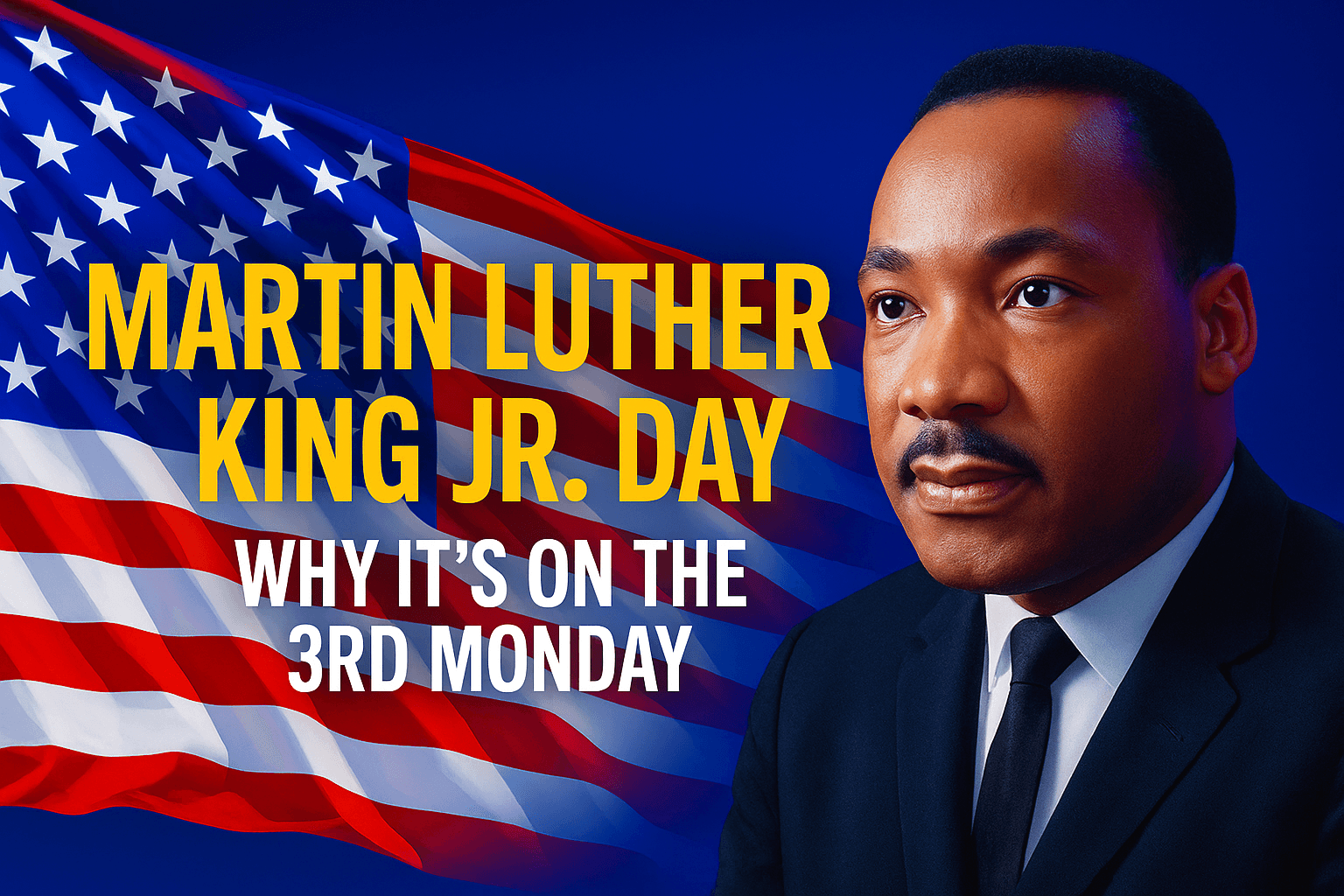
Every year in the United States, one special day stands out as a powerful reminder of justice, equality, and peace — Martin Luther King Jr. Day. Celebrated on the third Monday of January, this day honors the life and legacy of Dr. Martin Luther King Jr., the iconic civil rights leader who transformed American history through his courage, leadership, and nonviolent philosophy.
But why exactly is Martin Luther King Jr. Day celebrated on the 3rd Monday?
Why not on January 15 — his actual birthday — or some other date?
To understand this, we must explore the history behind the holiday, the movement that made it possible, and how its timing is connected to American traditions and federal laws.
This blog post explains everything in detail, from the meaning of MLK Day to the reasons behind the 3rd-Monday rule — written in simple, clear language and optimized for SEO.
Who Was Martin Luther King Jr.? (Short Overview)
Before understanding the holiday, it’s important to know who MLK was.
Dr. Martin Luther King Jr. (1929–1968) was:
- A leader of the American Civil Rights Movement
- An advocate of nonviolent protest
- A preacher and activist who inspired millions
- The man behind historic moments like the
Montgomery Bus Boycott,
March on Washington, and
“I Have a Dream” speech
His message focused on racial equality, justice, and peaceful change.
Because of his impact, he was awarded the Nobel Peace Prize in 1964.
After his assassination in 1968, people across the country began pushing for a national holiday in his honor.
When Was Martin Luther King Jr. Day Created?
Though MLK passed away in 1968, the U.S. government did not immediately declare a holiday in his name.
Here is the timeline:
1968
Right after King’s assassination, many politicians and community leaders demanded a federal holiday.
1979
Congress voted — but the bill failed by a small margin.
1983
President Ronald Reagan signed the bill into law, officially establishing Martin Luther King Jr. Day as a federal holiday.
1986
MLK Day was celebrated nationwide for the first time.
2000
All 50 states began observing MLK Day (after some states initially resisted).
So, the creation of this holiday took more than 15 years of public pressure, marches, petitions, and political debate.
Why Is Martin Luther King Jr. Day on the 3rd Monday of January?
This is the main question of the post.
To understand the answer, let’s break it down.
Reason 1: It’s Close to King’s Birthday (January 15)
Martin Luther King Jr. was born on January 15, 1929.
Putting the holiday on the third Monday ensures:
- It always falls between January 15 and January 21
- It stays close to the actual birthday
- Schools and workplaces get a predictable long weekend
This maintains the symbolic meaning while keeping the schedule consistent.
Reason 2: The Uniform Monday Holiday Act (1968)
This is the most important reason.
In 1968, the U.S. Congress passed a law known as the Uniform Monday Holiday Act.
The purpose of the act was to:
- Move certain federal holidays to Mondays
- Create three-day weekends
- Make holiday planning easier for families
- Boost the economy through travel and tourism
Because of this act, holidays like:
- Presidents’ Day
- Memorial Day
- Labor Day
are also set on Mondays.
When MLK Day was added in 1983, lawmakers followed the same rule — placing it on a Monday instead of a fixed date.
This is why the holiday doesn’t fall exactly on January 15 each year but stays close to it.
Reason 3: Encouraging National Participation (Day of Service)
MLK Day is unique because it is the only U.S. holiday recognized as a National Day of Service.
People are encouraged to:
- volunteer
- help their community
- support charitable causes
Because schools, offices, and government offices are closed on Monday, it becomes easier for millions of Americans to take part in service projects and events.
A Monday holiday provides:
- More time for community programs
- Higher volunteer participation
- More organized nationwide activities
A mid-week holiday would not have allowed such large community engagement.
Reason 4: It Prevents the Holiday From Falling on a Weekend
If MLK Day were set on January 15 every year, the date would sometimes fall on:
- Saturday
- Sunday
When a holiday lands on a weekend, many people do not observe it fully.
Schools are closed anyway, and workplaces often do not give additional days off.
By placing it on the third Monday, the holiday is always fully observed, and the purpose of honoring MLK is better achieved.
Why the Third Monday Matters More Than the Exact Date
Some people once argued the holiday should be on January 15 (his real birthday).
But the third Monday has advantages:
✔️ Consistency
Always on the same weekday
Easy to plan for every year
Avoids confusion
✔️ Long Weekend
Helps families participate in events
Encourages national travel and tourism
Supports school activities
✔️ Alignment with Other U.S. Holidays
Fits the federal Monday-holiday pattern
Keeps government scheduling organized
✔️ Boosts Volunteerism
More people can join service projects
More organizations can coordinate events
So, choosing the third Monday helps the holiday reach more people, not fewer.
How Americans Celebrate Martin Luther King Jr. Day
MLK Day isn’t just a day off.
It’s a day to reflect, learn, and serve.
Here are common ways people celebrate:
1. Community Service Activities
The holiday is known as “A Day On, Not a Day Off”.
People take part in:
- cleaning neighborhoods
- donating food
- helping elderly homes
- organizing charity events
- supporting children’s education
- planting trees and environmental work
Churches, schools, and NGOs run thousands of volunteer programs nationwide.
2. Educational Programs
Schools and universities host:
- seminars on civil rights
- workshops about equality
- discussions on MLK’s speeches
- film screenings and exhibitions
Students learn about the importance of justice, peace, and diversity.
3. Parades and Marches
Many cities hold:
- peace marches
- unity parades
- public speeches
These events honor the civil rights movement and celebrate diversity.
4. Visiting Historic Sites
People visit:
- The Martin Luther King Jr. Memorial (Washington, D.C.)
- The King Center (Atlanta, Georgia)
- MLK’s birthplace and church
- Civil rights museums
These places help preserve the memory of the struggle for equality.
5. Listening to MLK’s Famous Speeches
His most famous speech, “I Have a Dream,” is played across schools, radio, and TV.
Other speeches like:
- “Letter from Birmingham Jail”
- “The Drum Major Instinct”
- “I’ve Been to the Mountaintop”
are studied for their powerful messages of justice and humanity.
The Deeper Meaning of MLK Day
Beyond the celebrations, MLK Day carries strong values:
1. Equality
MLK believed all people deserve equal rights, regardless of race, religion, or background.
2. Nonviolence
He followed the teachings of Mahatma Gandhi and promoted peaceful protest.
3. Justice
He fought segregation and worked for fair laws.
4. Unity
He encouraged people to stand together and support each other.
5. Hope
His “dream” continues to inspire millions worldwide.
Why MLK Day Still Matters Today
Even decades after his death, the messages of MLK remain relevant.
Many social issues such as:
- racial discrimination
- inequalities in education and opportunities
- economic injustice
- hate crimes
- prejudice
still exist.
MLK Day reminds us to:
- speak up against injustice
- respect diversity
- help the less fortunate
- treat people with compassion
- work toward a fair society
The holiday is not just about the past — it’s about improving the present and future.
Final Thoughts
Martin Luther King Jr. Day is much more than a long weekend or a federal break from work and school — it is a reminder of the courage, determination, and vision of a man who changed the course of American history. Celebrated every year on the third Monday of January, the holiday reflects a thoughtful blend of practicality and purpose. By placing it close to King’s actual birthday and aligning it with the Uniform Monday Holiday Act, the United States ensured that more people could participate in meaningful activities, educational programs, and community service projects.
But beyond its scheduling, MLK Day carries a deeper message. It asks each of us to reflect on the values Dr. King lived and died for — equality, justice, compassion, and peaceful resistance against wrongdoing. His dream of a world where people are judged not by the color of their skin but by the content of their character remains as powerful and necessary today as it was decades ago.
As we observe this day, we are encouraged not only to remember King’s legacy but also to act on it. By helping others, speaking up for fairness, and treating everyone with dignity, we keep his dream alive. Ultimately, MLK Day reminds us that real change begins with ordinary people choosing to do what is right — one voice, one action, and one day at a time.
If you don’t want to read, you can watch the video by clicking on this Link…
https://youtu.be/WthBBilBhOs?si=m3zKsJkss775Cz8E
https://onlinehelpful.com/blog/
Frequently Asked Questions
1. Why is Martin Luther King Jr. Day celebrated on the 3rd Monday of January?
MLK Day falls on the 3rd Monday to keep the holiday close to King’s birthday (January 15) and to follow the Uniform Monday Holiday Act, which schedules certain federal holidays on Mondays to create a consistent long weekend.
2. Is Martin Luther King Jr. Day always on the same date?
No. The date changes every year, but the day is always the third Monday of January. This means it can fall between January 15 and January 21.
3. Why wasn’t MLK Day put on January 15, his actual birthday?
Lawmakers chose a Monday instead of a fixed date to allow a national day of service, increase public participation, and align with other federal Monday holidays. This ensures more people can take part in community activities.
4. When was Martin Luther King Jr. Day first celebrated?
MLK Day was celebrated for the first time nationwide on January 20, 1986, three years after President Ronald Reagan signed the bill establishing the holiday.
5. Which states were last to recognize MLK Day?
By the year 2000, all 50 states officially recognized MLK Day. Some states initially resisted or combined it with other holidays before giving it full recognition.
6. What is the main purpose of Martin Luther King Jr. Day?
The holiday honors Dr. King’s legacy and promotes equality, nonviolence, and justice. It is also known as a National Day of Service, encouraging people to volunteer and help their communities.
7. Is MLK Day a federal holiday?
Yes. MLK Day is a federal holiday, which means government offices, banks, schools, and many businesses close in observance.
8. How do people usually celebrate MLK Day?
People celebrate by joining volunteer programs, attending educational events, visiting civil rights museums, listening to King’s speeches, and participating in peace marches or community services.
9. Why is MLK Day called a “Day On, Not a Day Off”?
This slogan encourages Americans to use the day for meaningful action—helping others, supporting social causes, and strengthening their communities—rather than simply taking a break from work or school.
10. What values does MLK Day focus on?
MLK Day emphasizes equality, justice, compassion, unity, hope, and the power of peaceful change. These values reflect Dr. King’s lifelong mission.