
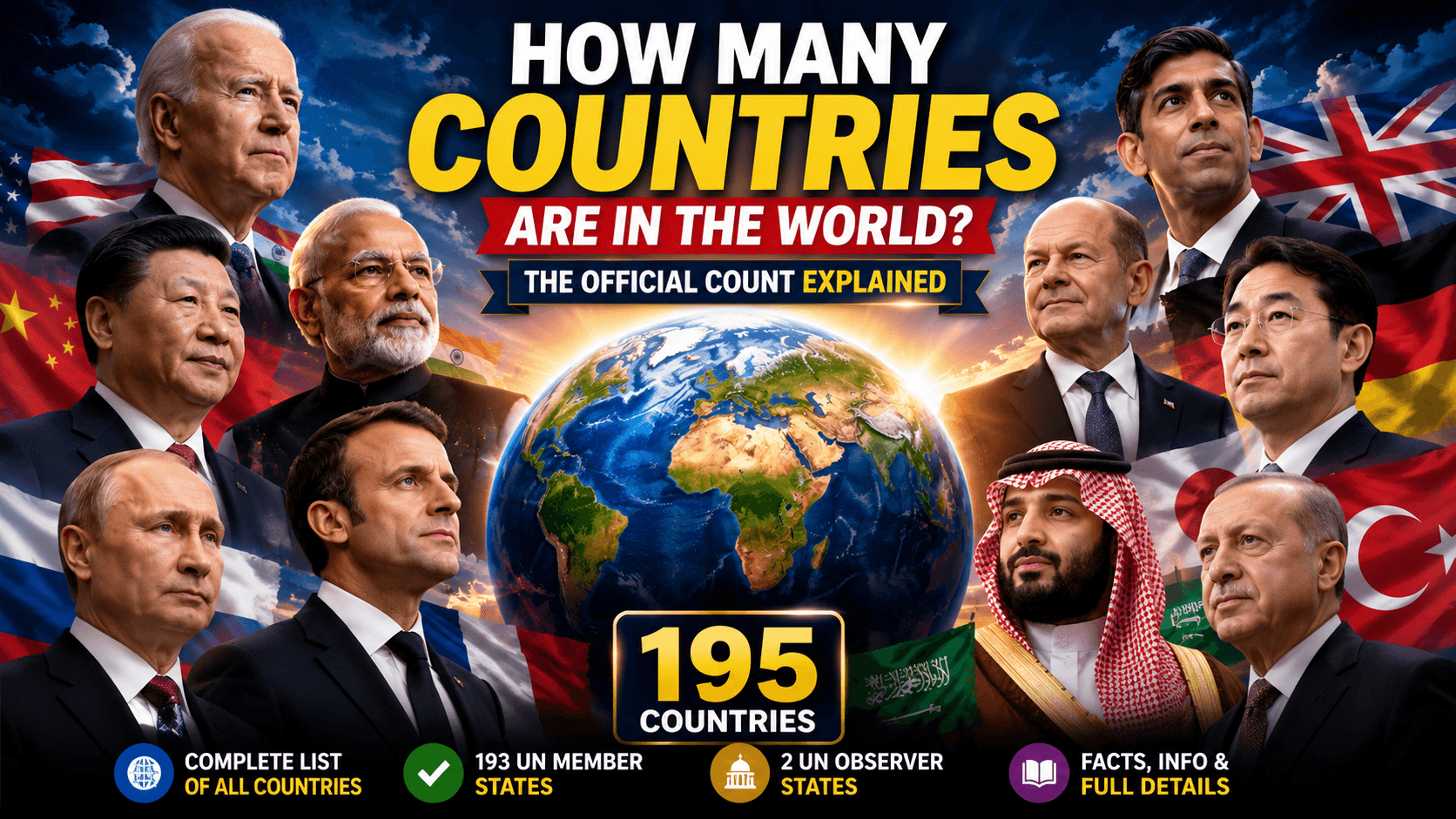
How Many Countries Are in the World? The Official Count Explained
Many people around the world often ask the same geography question: “How many countries are there in the world?” Although the question appears straightforward, the correct answer depends on the criteria used to officially recognize a country. Different international organizations and governments may follow different standards for recognition. According to the most widely accepted international standard, there are 195 countries in the world today.
This total includes:
- 193 member states of the United Nations (UN).
- The remaining two are UN observer states: Vatican City (the Holy See) and the State of Palestine.
These 195 countries are recognized by most governments, international organizations, and educational institutions around the world.
Why Do Some Sources Mention 197 or Even More Countries?
You may have seen websites or books that say there are 197 countries, 198 countries, or even more. This happens because different organizations use different criteria for counting countries.
Certain lists also count regions that govern themselves but are not officially recognized as independent countries by every nation. Others may count places that have limited international recognition.
Examples include:
- Taiwan
- Kosovo
These places have their own governments and function like independent countries in many ways. However, because not all United Nations member states officially recognize them as sovereign nations, they are not included in the widely accepted total of 195 countries.
What Makes a Place a Country?
A country is generally expected to meet several important requirements:
- It has a permanent population.
- It has clearly defined borders.
- It has its own government.
- It can establish relationships with other countries.
- It exercises control over its own territory.
Even if a place meets these conditions, international recognition also plays an important role in whether it is widely accepted as an independent country.
How Are the 195 Countries Distributed?
The world’s countries are spread across different continents:
- Africa: 54 countries
- Asia: 48 countries
- Europe: 44 countries
- North America: 23 countries
- South America: 12 countries
- Oceania: 14 countries
These numbers may vary slightly depending on how certain territories are classified, but they provide a good overview of the global distribution.
Why Is the Number Important?
Knowing the official number of countries helps in many areas, including:
- Learning world geography.
- Preparing for competitive exams and quizzes.
- Understanding international politics.
- Studying global cultures and economies.
- Improving general knowledge.
Students, travelers, teachers, and geography enthusiasts often refer to the official count of 195 countries when discussing the world.
Key Facts at a Glance
- Officially recognized countries: 195
- UN Member States: 193
- UN Observer States: 2 (Vatican City and Palestine)
- Largest country by area: Russia
- Smallest country: Vatican City
- Most accepted global count: 195 countries
Understanding why different numbers appear online can prevent confusion. While some sources include territories with partial recognition, the internationally accepted answer remains 195 countries based on the United Nations’ recognition system.
Complete List of the 195 Officially Recognized Countries in the World
| No. | Country | No. | Country |
|---|---|---|---|
| 1 | Afghanistan | 99 | Lithuania |
| 2 | Albania | 100 | Luxembourg |
| 3 | Algeria | 101 | Madagascar |
| 4 | Andorra | 102 | Malawi |
| 5 | Angola | 103 | Malaysia |
| 6 | Antigua and Barbuda | 104 | Maldives |
| 7 | Argentina | 105 | Mali |
| 8 | Armenia | 106 | Malta |
| 9 | Australia | 107 | Marshall Islands |
| 10 | Austria | 108 | Mauritania |
| 11 | Azerbaijan | 109 | Mauritius |
| 12 | Bahamas | 110 | Mexico |
| 13 | Bahrain | 111 | Micronesia |
| 14 | Bangladesh | 112 | Moldova |
| 15 | Barbados | 113 | Monaco |
| 16 | Belarus | 114 | Mongolia |
| 17 | Belgium | 115 | Montenegro |
| 18 | Belize | 116 | Morocco |
| 19 | Benin | 117 | Mozambique |
| 20 | Bhutan | 118 | Myanmar |
| 21 | Bolivia | 119 | Namibia |
| 22 | Bosnia and Herzegovina | 120 | Nauru |
| 23 | Botswana | 121 | Nepal |
| 24 | Brazil | 122 | Netherlands |
| 25 | Brunei | 123 | New Zealand |
| 26 | Bulgaria | 124 | Nicaragua |
| 27 | Burkina Faso | 125 | Niger |
| 28 | Burundi | 126 | Nigeria |
| 29 | Cabo Verde | 127 | North Korea |
| 30 | Cambodia | 128 | North Macedonia |
| 31 | Cameroon | 129 | Norway |
| 32 | Canada | 130 | Oman |
| 33 | Central African Republic | 131 | Pakistan |
| 34 | Chad | 132 | Palau |
| 35 | Chile | 133 | Palestine |
| 36 | China | 134 | Panama |
| 37 | Colombia | 135 | Papua New Guinea |
| 38 | Comoros | 136 | Paraguay |
| 39 | Congo | 137 | Peru |
| 40 | Costa Rica | 138 | Philippines |
| 41 | Côte d’Ivoire | 139 | Poland |
| 42 | Croatia | 140 | Portugal |
| 43 | Cuba | 141 | Qatar |
| 44 | Cyprus | 142 | Romania |
| 45 | Czech Republic | 143 | Russia |
| 46 | Democratic Republic of the Congo | 144 | Rwanda |
| 47 | Denmark | 145 | Saint Kitts and Nevis |
| 48 | Djibouti | 146 | Saint Lucia |
| 49 | Dominica | 147 | Saint Vincent and the Grenadines |
| 50 | Dominican Republic | 148 | Samoa |
| 51 | Ecuador | 149 | San Marino |
| 52 | Egypt | 150 | São Tomé and Príncipe |
| 53 | El Salvador | 151 | Saudi Arabia |
| 54 | Equatorial Guinea | 152 | Senegal |
| 55 | Eritrea | 153 | Serbia |
| 56 | Estonia | 154 | Seychelles |
| 57 | Eswatini | 155 | Sierra Leone |
| 58 | Ethiopia | 156 | Singapore |
| 59 | Fiji | 157 | Slovakia |
| 60 | Finland | 158 | Slovenia |
| 61 | France | 159 | Solomon Islands |
| 62 | Gabon | 160 | Somalia |
| 63 | Gambia | 161 | South Africa |
| 64 | Georgia | 162 | South Korea |
| 65 | Germany | 163 | South Sudan |
| 66 | Ghana | 164 | Spain |
| 67 | Greece | 165 | Sri Lanka |
| 68 | Grenada | 166 | Sudan |
| 69 | Guatemala | 167 | Suriname |
| 70 | Guinea | 168 | Sweden |
| 71 | Guinea-Bissau | 169 | Switzerland |
| 72 | Guyana | 170 | Syria |
| 73 | Haiti | 171 | Tajikistan |
| 74 | Honduras | 172 | Tanzania |
| 75 | Hungary | 173 | Thailand |
| 76 | Iceland | 174 | Timor-Leste |
| 77 | India | 175 | Togo |
| 78 | Indonesia | 176 | Tonga |
| 79 | Iran | 177 | Trinidad and Tobago |
| 80 | Iraq | 178 | Tunisia |
| 81 | Ireland | 179 | Türkiye |
| 82 | Israel | 180 | Turkmenistan |
| 83 | Italy | 181 | Tuvalu |
| 84 | Jamaica | 182 | Uganda |
| 85 | Japan | 183 | Ukraine |
| 86 | Jordan | 184 | United Arab Emirates |
| 87 | Kazakhstan | 185 | United Kingdom |
| 88 | Kenya | 186 | United States |
| 89 | Kiribati | 187 | Uruguay |
| 90 | Kuwait | 188 | Uzbekistan |
| 91 | Kyrgyzstan | 189 | Vanuatu |
| 92 | Laos | 190 | Vatican City |
| 93 | Latvia | 191 | Venezuela |
| 94 | Lebanon | 192 | Vietnam |
| 95 | Lesotho | 193 | Yemen |
| 96 | Liberia | 194 | Zambia |
| 97 | Libya | 195 | Zimbabwe |
| 98 | Liechtenstein |
Why Do Different Sources List Different Numbers of Countries?
When searching for this question online, you may find that different websites provide different answers. Some say 195 countries, while others mention 197, 198, or even more. This often confuses students, travelers, and anyone interested in geography. The reason is that there is no single global authority that every nation follows when recognizing independent countries.
The Most Accepted Answer Is 195 Countries
The number 195 is the most widely accepted worldwide because it includes:
- 193 United Nations (UN) member states.
- 2 UN observer states: Vatican City and Palestine.
Most schools, governments, international organizations, and geography references use this count.
Why Do Some Lists Include 197 Countries?
Some sources count regions that function as independent countries, even though they are not officially recognized by all nations.
For example:
- Taiwan has its own government, military, currency, and economy. However, not every country officially recognizes it as a sovereign nation.
- Kosovo declared its independence in 2008 and has been recognized by many countries, although some nations still do not officially accept it as an independent state.
If these two territories are included alongside the officially recognized 195 countries, the total increases to 197.
Recognition Is Different from Independence
A region may have its own government and function like an independent country, but global recognition depends on international acceptance.
Recognition depends on diplomatic relationships between nations. Some governments officially recognize a territory as a country, while others do not. As a result, different organizations and sources may report different totals for the number of countries in the world.
Territories Are Not Usually Counted as Countries
Many places around the world have their own local governments but remain territories of another country.
Examples include:
- Greenland
- Puerto Rico
- Bermuda
- Hong Kong
- Macau
These places have varying degrees of self-government, but they are generally not considered independent countries because they remain connected to another sovereign nation.
Why Geography Books May Differ
Geography books, travel guides, and educational websites are written for different purposes.
Some resources:
- Follow only the United Nations list.
- Include countries with limited recognition.
- Count overseas territories separately.
- Use older political data that has not been updated.
This explains why you may find different totals depending on where you look.
Which Number Should You Use?
For school projects, competitive exams, quizzes, and general knowledge, the safest and most accurate answer is:
- 195 countries worldwide
- 193 UN member states
- 2 UN observer states
If a source uses 197 countries, it is usually because it also includes Taiwan and Kosovo.
Quick Summary
Here are the key points to remember:
- 195 is the official and most widely accepted number of countries.
- Different sources use different recognition standards.
- Taiwan and Kosovo are the main reason some lists show 197 countries.
- Territories are generally not counted as independent countries.
- Always check how a source defines a “country” before comparing numbers.
Understanding these differences helps explain why multiple answers appear online, even though 195 countries remains the standard figure accepted by most international organizations and educational institutions.
Conclusion
At first glance, the question “How many countries are there in the world?” seems easy to answer. However, the actual number depends on international recognition, diplomatic status, and how countries are acknowledged by the global community. The most widely accepted and official count is 195 countries, consisting of 193 United Nations member states and 2 UN observer states. While some sources mention 197 countries by including Taiwan and Kosovo, the difference comes from varying political recognition rather than changes in geography.
Understanding why different numbers exist helps avoid confusion and provides a clearer picture of how countries are recognized around the world. Whether you are a student, traveler, quiz enthusiast, or simply curious about world geography, remembering the official figure of 195 countries is the most reliable choice. As global politics continue to evolve, country recognition may change over time, so referring to trusted and up-to-date international sources is always the best approach.
➤ Click this link to stay informed with the latest global updates, breaking news, and important events happening around the world.
https://onlinehelpful.com/category/global-updates/
➤ Prefer watching instead of reading? Click the link below to view the complete video guide.
https://youtu.be/EoPrJrNcRO4?si=Up6eLmXtTXKm4fxj
Frequently Asked Questions
Q1. How many countries are officially recognized in the world?
Answer: There are 195 officially recognized countries in the world. This total includes 193 United Nations (UN) member states and 2 UN observer states—Vatican City and Palestine. This is the most widely accepted number used by governments, schools, and international organizations.
Q2. Why do some websites say there are 197 countries?
Answer: Some websites list 197 countries because they also include Taiwan and Kosovo. These territories operate with their own governments but are not universally recognized as independent countries by all UN member states. As a result, different sources may use different totals.
Q3. Which organization is responsible for the official country count?
Answer: The United Nations (UN) is the most trusted international organization for determining the widely accepted number of countries. Although the UN does not officially publish a “world country count,” the total of 193 member states plus 2 observer states is recognized globally as the standard.
Q4. Can the number of countries in the world change?
Answer: Yes. The number of countries can change if a new nation gains widespread international recognition, if countries merge, or if political boundaries change. However, such changes are uncommon, so the current internationally accepted total remains 195 countries.