
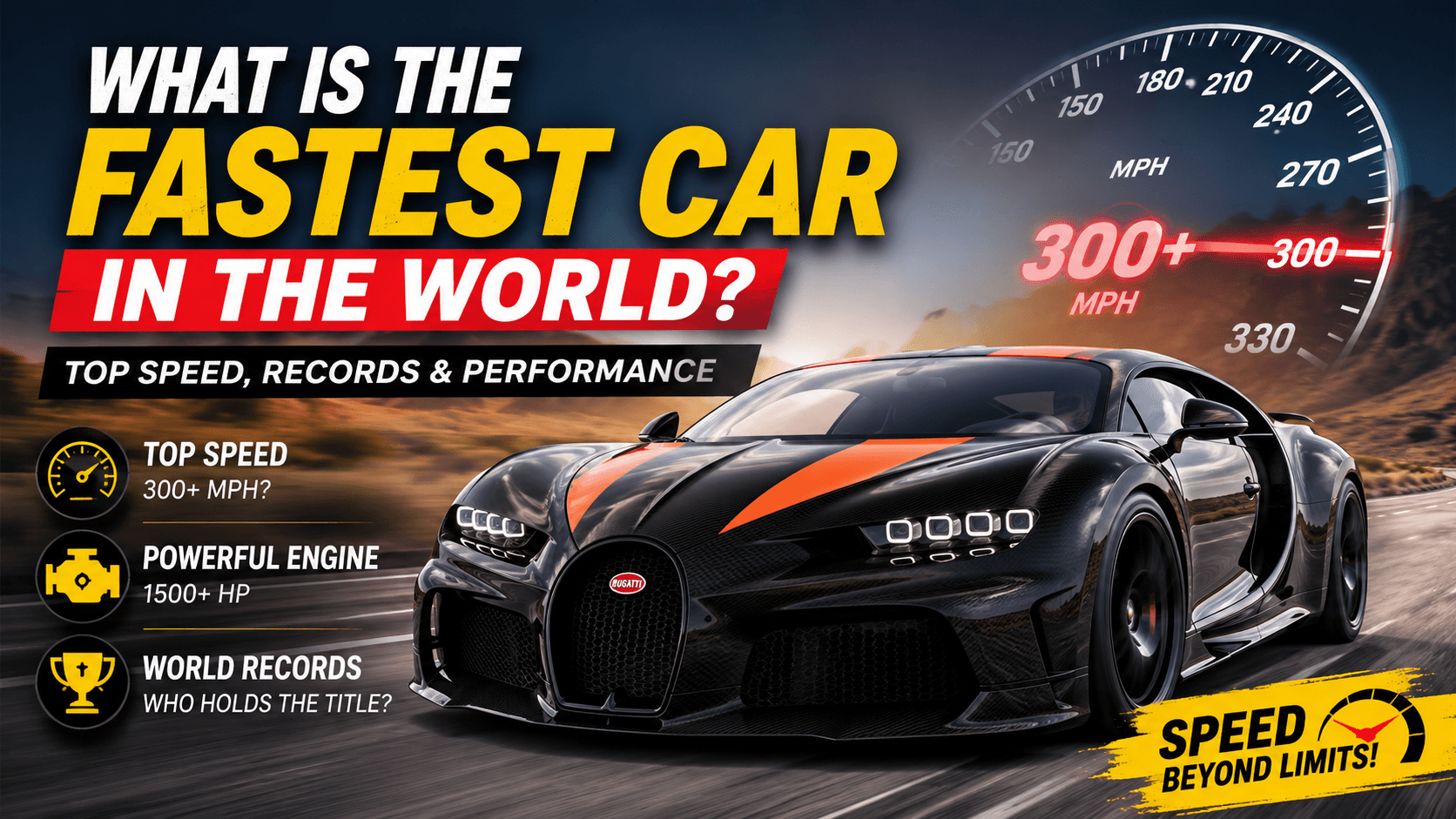
Which Car Is the Fastest in the World?
The title of the fastest car in the world is highly competitive because manufacturers continue to develop faster and more powerful hypercars every year. While many supercars can exceed 200 mph (322 km/h), only a few are capable of crossing the 300 mph (483 km/h) mark.
Several high-performance hypercars are widely recognized among the fastest vehicles ever built. Some of the most notable examples include:
- Bugatti Chiron Super Sport 300+ – Famous for breaking the 300 mph barrier during a controlled speed test.
- Koenigsegg Jesko Absolut – Engineered to push the limits of speed, this hypercar was created with the ambition of setting a new benchmark as one of the fastest production cars in the world.
- SSC Tuatara – Known for its lightweight design and powerful twin-turbocharged V8 engine.
- Hennessey Venom F5 – Built to deliver exceptional speed with over 1,800 horsepower.
- Rimac Nevera – An all-electric hypercar that combines incredible acceleration with advanced technology.
- Bugatti Bolide – A track-focused hypercar engineered for extreme performance.
It is important to understand that the “fastest car” title can vary depending on how speed is measured.
- Official Speed Record – Achieved during verified testing under controlled conditions.
- Claimed Top Speed – The maximum speed estimated or announced by the manufacturer.
These hypercars are capable of delivering extraordinary performance because they feature:
- Engines producing more than 1,500 horsepower.
- Acceleration from 0 to 60 mph (0–97 km/h) in under three seconds.
- Lightweight carbon-fiber construction for improved speed and handling.
- Advanced aerodynamics to reduce drag and increase stability.
- High-performance suspension, braking systems, and tires designed for extreme speeds.
Although these cars cost millions of dollars and are produced in very limited numbers, they showcase the highest level of automotive engineering. As manufacturers continue to compete for new speed records, the race to build the world’s fastest car becomes even more exciting for car enthusiasts around the globe.
Top Speed, Engine, and Performance
The world’s fastest cars are not only known for their incredible top speeds but also for their powerful engines and outstanding overall performance. Every component, from the engine to the aerodynamics, is carefully designed to help these hypercars achieve maximum speed while remaining stable and safe.
Top Speed
A car’s top speed refers to the highest speed it can achieve under ideal driving conditions. The fastest hypercars in the world are capable of reaching speeds well above 250 mph (402 km/h), while a select few have crossed or targeted the 300 mph (483 km/h) milestone.
Several factors affect a car’s top speed, including:
- Engine power
- Vehicle weight
- Aerodynamic design
- Transmission efficiency
- Road and weather conditions
Manufacturers spend years testing and improving these factors to achieve record-breaking performance.
Engine
The engine is the heart of every high-performance car. Modern hypercars use advanced technology to produce extraordinary horsepower and torque.
Common engine features include:
- Twin-turbocharged V8 or W16 engines
- More than 1,500 horsepower
- High torque for rapid acceleration
- Advanced cooling systems
- Lightweight engine components for better efficiency
Some of the latest hypercars also use electric motors or hybrid powertrains to deliver instant power while improving overall performance.
Performance
Performance is more than just top speed. It also includes acceleration, handling, braking, and overall driving stability.
Key performance features include:
- 0–60 mph (0–97 km/h) in under 3 seconds
- Carbon-fiber body for reduced weight
- Advanced aerodynamic body design
- High-performance suspension system
- Powerful carbon-ceramic braking system
- Specially designed high-speed tires
These technologies help drivers maintain better control even at extremely high speeds.
Why Performance Matters
A powerful engine alone cannot make a car the fastest in the world. The vehicle must also remain stable, efficient, and safe while traveling at incredible speeds. Engineers carefully balance power, aerodynamics, weight, and braking performance to achieve the best possible results.
As automotive technology continues to evolve, future hypercars are expected to become even faster through improved engine designs, electric powertrains, lightweight materials, and smarter performance systems. These innovations ensure that the competition to build the world’s fastest car will continue for many years to come.
Conclusion
The world’s fastest cars represent the highest level of innovation, engineering, and performance in the automotive industry. Hypercars such as the Bugatti Chiron Super Sport 300+, Koenigsegg Jesko Absolut, SSC Tuatara, Hennessey Venom F5, Rimac Nevera, and Bugatti Bolide demonstrate what is possible when cutting-edge technology meets exceptional design. While top speed is often the main attraction, true performance also depends on engine power, lightweight construction, advanced aerodynamics, braking capability, and overall driving stability. As manufacturers continue to push the limits with more powerful engines, electric powertrains, and innovative materials, the competition for the title of the world’s fastest car is becoming even more exciting. These extraordinary vehicles not only set new speed records but also inspire future advancements that influence the broader automotive industry, making them a true symbol of engineering excellence and technological progress.
➤ Click this link to stay informed with the latest global updates, breaking news, and important events happening around the world.
https://onlinehelpful.com/category/global-updates/
➤ Prefer watching instead of reading? Click the link below to view the complete video guide.
https://youtu.be/LOjVqgYCRRU?si=aFU4b-lgsI2yg2TE
Frequently Asked Questions
Q1. Which is the fastest car in the world?
Answer: The title of the fastest car in the world depends on officially verified speed records and manufacturer claims. Cars such as the Bugatti Chiron Super Sport 300+, Koenigsegg Jesko Absolut, SSC Tuatara, and Hennessey Venom F5 are among the fastest hypercars ever built.
Q2. What is the top speed of the fastest car?
Answer: The world’s fastest hypercars can reach top speeds of 300 mph (483 km/h) or more under ideal conditions. However, officially verified speeds and manufacturer-claimed speeds may differ.
Q3. Which engine is used in the fastest cars?
Answer: Most of the fastest cars use twin-turbocharged V8 or W16 engines that produce more than 1,500 horsepower. Some modern hypercars also use electric or hybrid powertrains for even better performance.
Q4. How fast can the fastest car accelerate?
Answer: Many of the world’s fastest hypercars can accelerate from 0 to 60 mph (0–97 km/h) in less than 3 seconds, making them some of the quickest production vehicles ever created.
Q5. Why are the fastest cars so expensive?
Answer: Fastest cars are expensive because they are built with advanced engineering, carbon-fiber materials, powerful engines, cutting-edge technology, and limited production numbers. These features make them rare, highly exclusive, and extremely high-performing.