
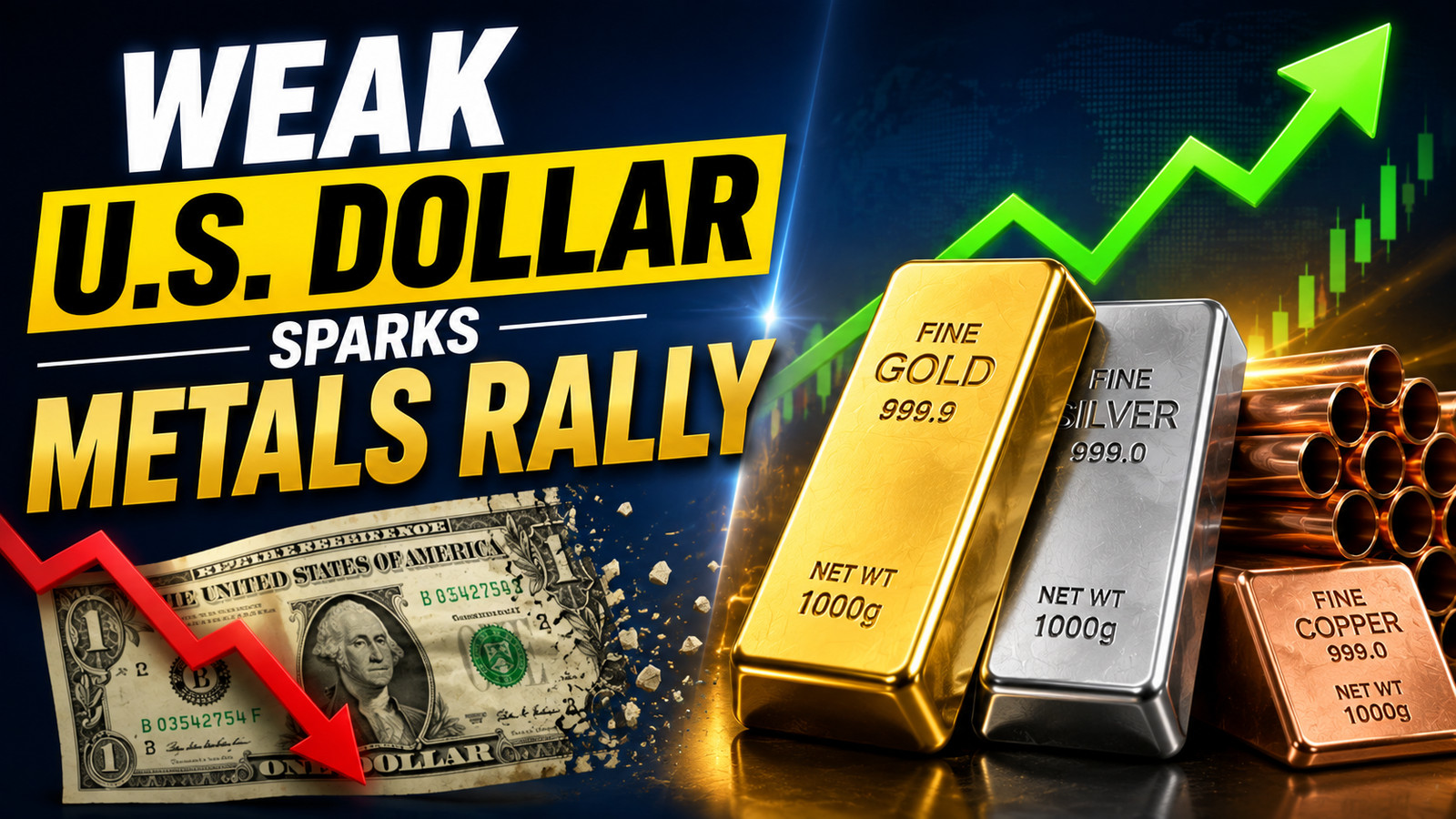
Weak U.S. Dollar Sparks a Metals Rally
A weaker U.S. dollar can have a powerful effect on global commodity markets, and metals are often among the first assets to respond. When the dollar loses value against other major currencies, gold, silver, copper, and other metals can become more attractive to international buyers because many commodities are priced in U.S. dollars.
The relationship between the dollar and metals is not always perfectly inverse, but historically, periods of dollar weakness have often provided support for precious and industrial metals. Investors closely watch this relationship because a sustained decline in the dollar can influence commodity prices, inflation expectations, global demand, and investment flows.
Why Does a Weak Dollar Matter for Metals?
Most major metals traded internationally are priced in U.S. dollars. When the dollar becomes weaker, buyers using other currencies may find those metals relatively cheaper. This can encourage additional demand and provide upward pressure on prices.
For example, if the dollar declines while the international price of gold remains unchanged in dollar terms, gold may effectively become less expensive for someone holding euros, pounds, yen, or another currency. Increased purchasing interest can then contribute to a rise in the dollar-denominated price of the metal.
Gold is particularly sensitive to movements in the dollar because investors often view it as a store of value and a potential hedge during periods of currency uncertainty.
Silver can also benefit from dollar weakness. Unlike gold, silver has substantial industrial applications, including electronics, solar technology, and other manufacturing processes. This means its price can be influenced by both investment demand and industrial demand.
Gold and Silver Often Attract Investor Attention
When confidence in the dollar declines, investors may look for alternative stores of value. Gold has historically played an important role in this environment.
Several factors can increase interest in gold:
- A weaker U.S. dollar
- Expectations of lower interest rates
- Inflation concerns
- Economic uncertainty
- Geopolitical risks
- Strong central-bank demand
- Increased investor demand for safe-haven assets
Silver can experience similar effects, although its market dynamics are different. Because silver is heavily used in industry, its performance can depend on the health of the global economy as well as currency movements.
The Role of Interest Rates
The dollar’s direction is closely connected to expectations surrounding U.S. monetary policy. If investors expect the Federal Reserve to reduce interest rates, the dollar may face downward pressure, depending on how those expectations compare with monetary policy elsewhere.
Lower interest rates can also make non-interest-bearing assets such as gold relatively more appealing. Gold does not pay interest or dividends, so its opportunity cost can become more favorable when yields on cash and bonds decline.
However, this relationship is not automatic. Metals prices are influenced by multiple factors at the same time, and a stronger dollar does not necessarily guarantee falling metals prices.
Why Investors Are Watching the Metals Market
A broad metals rally can provide important signals about investor expectations. Precious metals may reflect concerns about currencies, inflation, interest rates, and economic uncertainty, while industrial metals can offer clues about manufacturing activity and global economic demand.
Copper, for instance, is widely used in construction, electrical equipment, power infrastructure, transportation, and renewable-energy technologies. Therefore, its price can respond not only to currency movements but also to expectations for global economic growth.
This makes the current metals market particularly interesting. A weak dollar can provide a supportive backdrop, but the sustainability of a rally depends on whether other fundamental factors also remain favorable.
Is a Weak Dollar Enough to Keep Metals Rising?
Not necessarily. Currency movements are only one part of the metals-price equation.
Investors also need to consider:
- Federal Reserve policy
- U.S. economic data
- Global economic growth
- Inflation trends
- Central-bank purchases
- Industrial demand
- Mining supply
- Geopolitical developments
- Investor positioning
If several of these factors point in the same direction, metals can experience stronger and more sustained price movements.
Ultimately, the relationship between the U.S. dollar and metals is complex. A weaker dollar can create a favorable environment for metals, but it is not the only reason prices move. Understanding the broader economic picture is therefore essential when evaluating a metals rally.
Why a Weak Dollar Lifts Gold and Silver Prices
A weak U.S. dollar is one of the important factors that can support higher prices for precious metals, particularly gold and silver. Because these metals are generally priced and traded internationally in U.S. dollars, changes in the value of the currency can influence how expensive they appear to buyers around the world.
When the dollar declines, gold and silver can become relatively more affordable for investors and businesses holding other currencies. This can potentially increase demand and create upward pressure on prices. However, the relationship is not automatic, and metals can also move because of interest rates, inflation, economic conditions, supply and demand, and investor sentiment.
The Relationship Between the Dollar and Precious Metals
Gold and the U.S. dollar have historically shown periods of an inverse relationship. This means that when the dollar weakens, gold can receive additional support. The relationship exists partly because gold is denominated in dollars in major international markets.
Consider a simple example. If an investor outside the United States holds euros and the dollar becomes weaker against the euro, the dollar price of gold may become relatively less expensive in the investor’s local currency, assuming other factors remain unchanged.
That can make gold more attractive to international buyers.
The same basic currency effect can apply to silver. However, silver has a much larger industrial component than gold, meaning its price can also be strongly influenced by manufacturing activity and technological demand.
Why Gold Benefits From Dollar Weakness
Gold has a unique position in global financial markets. It is widely viewed as a store of value and a potential hedge against economic and financial uncertainty.
When investors become less confident about the future direction of currencies or financial markets, some may increase their exposure to gold. A falling dollar can strengthen this appeal because gold is not tied to the creditworthiness of a particular government or company.
Several factors can reinforce gold demand during periods of dollar weakness:
- Lower expectations for U.S. interest rates
- Concerns about inflation
- Economic uncertainty
- Geopolitical tensions
- Central-bank gold purchases
- Increased demand for safe-haven assets
- Changes in investor positioning
These factors can work independently or together.
Why Silver Can Also Move Higher
Silver is different from gold because it has both investment and industrial demand. It is used in electronics, solar panels, electrical applications, medical equipment, and various manufacturing processes.
When the dollar weakens, international buyers may find silver more attractive in their own currencies. At the same time, expectations of stronger industrial activity can provide another source of demand.
This combination can sometimes produce significant price movements in silver.
However, silver is generally more volatile than gold. It can rise sharply during strong periods but can also experience larger declines when investor sentiment or industrial expectations deteriorate.
Interest Rates Are Another Major Factor
The dollar’s performance is closely connected to expectations about U.S. interest rates. When markets anticipate lower interest rates, the dollar can face pressure depending on the relative policy outlook in other major economies.
Lower rates can also benefit gold because gold does not generate interest income. When bond yields and other interest-bearing investments offer lower returns, the opportunity cost of holding gold may decline.
This does not mean that every rate cut automatically causes gold prices to rise. Financial markets often react to expectations before policy changes actually happen.
For this reason, investors pay close attention to Federal Reserve decisions, inflation reports, employment data, and other economic indicators that could influence future monetary policy.
Currency Movements Can Increase Global Demand
The global nature of the metals market makes currency movements particularly important. A U.S. investor and an investor in another country can experience very different returns from the same metal because exchange rates affect their local-currency prices.
For international investors, a weaker dollar can therefore change the attractiveness of dollar-denominated commodities.
If demand increases across multiple regions at the same time, it can provide additional support to metals prices.
A Weak Dollar Does Not Guarantee Higher Metals Prices
It is important not to assume that a falling dollar will always push gold and silver higher. Markets are influenced by several forces simultaneously.
For example, strong economic growth could increase industrial demand for silver and other metals, while higher interest rates could reduce demand for gold. Similarly, a major change in investor sentiment could overwhelm the effect of currency movements.
The dollar is an important factor, but it is only one part of the larger metals-market picture.
What Investors Should Watch
Anyone following gold and silver should look beyond the dollar index alone. Important indicators include:
- U.S. interest-rate expectations
- Federal Reserve policy
- Inflation data
- Bond yields
- Global economic growth
- Central-bank buying
- Industrial demand
- Mining supply
- Geopolitical developments
- Overall investor sentiment
Watching these factors together provides a much clearer picture of why precious metals are moving.
In short, a weaker U.S. dollar can make gold and silver more attractive to global investors and can provide an important boost to metals prices. But whether that support develops into a lasting rally depends on the broader economic environment, monetary policy, supply and demand, and investor confidence.
Which Metals Are Benefiting From the Dollar’s Decline?
A decline in the U.S. dollar can create a supportive environment for several metals, but not every metal responds in the same way. Gold and silver often receive the most attention because they are widely traded as precious metals, while copper and other industrial metals can respond to a combination of currency movements, economic expectations, and physical demand.
When the dollar weakens, metals priced in dollars can become relatively more affordable for buyers using other currencies. This can encourage international demand and potentially support prices. At the same time, investors may increase exposure to metals as a way to diversify portfolios or protect against currency and economic uncertainty.
The result can be a broad metals rally, although the strength and duration of the move depend on several other market conditions.
Gold Remains a Major Beneficiary
Gold is often one of the first metals investors watch when the dollar weakens. The precious metal has a long history as a store of value and is commonly used by investors seeking protection during periods of economic or financial uncertainty.
A weaker dollar can make gold relatively cheaper for international buyers. If demand increases, the dollar-denominated price of gold can receive additional upward pressure.
Gold can also benefit when investors expect interest rates to decline. Because gold does not pay interest, lower yields can reduce the opportunity cost of holding the metal.
Several factors can support gold at the same time:
- A weaker U.S. dollar
- Lower interest-rate expectations
- Falling bond yields
- Inflation concerns
- Geopolitical uncertainty
- Central-bank purchases
- Strong investment demand
However, gold prices can still fall even when the dollar is weak if other market forces become more powerful.
Silver Can See Stronger Price Movements
Silver is another major metal that can benefit from dollar weakness. Like gold, silver is priced internationally in dollars, so currency movements can influence its affordability for overseas buyers.
But silver has an important difference: it is both a precious metal and an industrial commodity.
Silver is used in a wide range of applications, including electronics, electrical equipment, solar technology, medical products, and manufacturing. As a result, its price can be affected by both investment demand and industrial activity.
When a weak dollar combines with strong industrial demand, silver can receive support from multiple directions.
Silver is also known for being more volatile than gold. This means that a strong metals rally can sometimes produce larger percentage gains in silver, but the metal can also experience sharper declines when market conditions change.
Copper Is Important to the Broader Metals Rally
Copper is not a precious metal, but it plays a major role in the global economy. It is widely used in construction, electrical infrastructure, transportation, electronics, renewable-energy systems, and manufacturing.
A weaker dollar can support copper prices by making dollar-priced commodities relatively more affordable for international buyers. But copper’s performance is also heavily dependent on expectations for global economic growth.
If investors believe manufacturing and construction activity will strengthen, demand expectations for copper may increase.
On the other hand, if global economic growth slows significantly, industrial demand could weaken even if the dollar remains under pressure.
This is why copper is sometimes viewed as an important indicator of economic expectations.
Platinum and Palladium Can Also Respond
Other precious and industrial metals, including platinum and palladium, can also be influenced by movements in the dollar.
Platinum has applications in automotive systems, industrial processes, jewelry, and other technologies. Palladium has also been heavily associated with automotive applications, particularly emissions-control systems.
Their prices depend on more than currency movements. Supply conditions, automotive demand, technological changes, recycling, and substitution can all influence their markets.
Therefore, a broad dollar decline does not guarantee that platinum or palladium will rise by the same amount as gold or silver.
Why Different Metals React Differently
One of the most important things to understand about a metals rally is that metals do not all have the same market structure.
Gold is strongly influenced by investment demand and monetary expectations. Silver has both monetary and industrial characteristics. Copper is much more closely connected to global manufacturing and construction. Platinum and palladium have their own specialized supply-and-demand dynamics.
This means the same economic event can produce different results across the metals market.
For example, a weaker dollar combined with expectations of lower interest rates could strongly support gold. Meanwhile, copper might need stronger evidence of improving global industrial demand before making a sustained move higher.
What Could Keep the Metals Rally Going?
For a metals rally to continue, several supportive conditions may need to remain in place.
These can include:
- Continued weakness in the U.S. dollar
- Expectations for lower interest rates
- Strong global commodity demand
- Healthy industrial activity
- Limited mining supply
- Continued central-bank purchases of gold
- Strong investment interest
- Rising demand from energy and technology industries
If multiple factors remain supportive, the rally could have a stronger foundation than a move driven solely by currency fluctuations.
What Could Stop the Rally?
There are also risks that could weaken metals prices. A sudden recovery in the dollar could make dollar-priced metals more expensive for international buyers. Higher-than-expected inflation could lead to expectations of tighter monetary policy, potentially supporting the dollar and increasing bond yields.
A slowdown in global manufacturing could also hurt industrial metals such as copper and silver.
For precious metals, a significant improvement in investor confidence could reduce demand for defensive assets.
Therefore, investors should avoid assuming that a weak dollar automatically means every metal will continue rising.
The Bigger Picture for the Metals Market
The current metals environment should be viewed as a combination of currency trends, monetary policy, investment demand, industrial activity, and supply conditions.
Gold and silver may benefit most directly from dollar weakness and changing interest-rate expectations, while copper and other industrial metals require stronger evidence of physical demand and economic growth.
A broad rally across several metals can indicate that investors are responding to more than just currency movements. If the dollar remains weak while demand for both precious and industrial metals stays strong, the metals market could continue attracting significant attention.
Ultimately, the dollar’s decline can provide an important tailwind for metals, but the strongest and most sustainable rallies usually occur when currency, investment, and fundamental demand factors are moving in the same direction.
What Is Driving the U.S. Dollar Lower?
The U.S. dollar plays a central role in global financial markets, and even relatively small changes in its value can influence currencies, commodities, stocks, bonds, and international trade. When the dollar weakens, investors often begin looking more closely at the reasons behind the move and what it could mean for markets.
A decline in the dollar is rarely caused by one factor alone. Interest-rate expectations, Federal Reserve policy, economic data, inflation, investor confidence, government finances, and global currency movements can all influence the dollar’s direction.
Understanding these factors is especially important for metals because gold, silver, copper, and many other commodities are priced internationally in U.S. dollars.
Federal Reserve Policy Is a Major Driver
One of the most important influences on the dollar is the expected direction of U.S. monetary policy.
The Federal Reserve adjusts interest rates in response to economic conditions, inflation, and employment. When investors expect U.S. interest rates to remain high, dollar-denominated assets can become more attractive because they may offer relatively higher returns.
However, when markets begin expecting lower U.S. interest rates, demand for the dollar can weaken.
Financial markets often react to expectations well before the Federal Reserve actually changes rates. This means comments from policymakers, economic reports, and inflation data can move the dollar significantly.
Interest-Rate Expectations Matter
Interest-rate differentials between the United States and other major economies are another important factor.
International investors frequently compare potential returns across different countries. If U.S. interest rates are expected to fall while rates elsewhere remain comparatively attractive, some capital may move away from dollar-denominated assets.
That can reduce demand for the dollar.
At the same time, lower rates can support commodities such as gold because the opportunity cost of holding a non-yielding asset may become less significant.
This is one reason expectations surrounding monetary policy can influence both the dollar and metals markets at the same time.
U.S. Economic Data Can Change Market Expectations
Economic reports provide investors with clues about the strength of the U.S. economy. Important indicators include employment, inflation, consumer spending, manufacturing activity, and economic growth.
If economic data comes in weaker than expected, investors may begin anticipating a more accommodative monetary-policy environment. That can put pressure on the dollar.
For example, weaker employment growth could increase expectations that the Federal Reserve may have more room to reduce interest rates. Similarly, cooling inflation could strengthen expectations for future rate cuts.
However, stronger-than-expected economic data can have the opposite effect by increasing expectations for higher rates or a longer period of restrictive policy.
Inflation Plays a Complicated Role
Inflation is another important part of the dollar story.
High inflation can sometimes create expectations for higher interest rates, which can support the dollar. But persistent inflation can also create concerns about the purchasing power of a currency.
This is why investors do not simply look at whether inflation is rising or falling. They also examine how inflation compares with interest rates, economic growth, and monetary-policy expectations.
Changes in inflation expectations can therefore influence both the dollar and precious metals.
Investor Confidence and Market Sentiment
Currency markets are heavily influenced by investor sentiment.
During periods of severe global uncertainty, investors may increase demand for the U.S. dollar because it remains one of the world’s most widely used reserve currencies. This can sometimes strengthen the dollar even when other economic indicators appear weak.
However, if investors become more comfortable with risk or believe conditions outside the United States are improving, money can move toward other currencies and assets.
This shift in capital flows can contribute to dollar weakness.
Global Currency Movements Also Matter
The dollar’s value is measured relative to other currencies, so developments outside the United States are equally important.
If the euro, Japanese yen, British pound, or other major currencies strengthen, the dollar can appear weaker on a relative basis.
Economic growth, interest-rate decisions, inflation, and political developments in other countries can therefore influence the dollar even when nothing major changes within the United States.
The dollar is part of a global currency system, not an isolated market.
Government Debt and Fiscal Concerns
Long-term concerns surrounding government borrowing and fiscal policy can also influence investor sentiment toward the dollar.
Large fiscal deficits and rising government debt do not automatically cause a currency to decline, but they can become part of the broader discussion about the long-term strength of the U.S. economy and public finances.
Investors may consider whether government spending, tax policies, borrowing requirements, and economic growth are sustainable over the long term.
These issues tend to matter more for longer-term currency expectations than for day-to-day price movements.
Why Dollar Weakness Matters for Metals
The dollar’s decline is particularly important for commodity markets because many commodities are priced in U.S. dollars.
When the dollar falls, commodities can become relatively cheaper for buyers using other currencies, potentially increasing international demand.
This can provide support to metals such as:
- Gold
- Silver
- Copper
- Platinum
- Palladium
However, each metal has its own supply-and-demand fundamentals, so the effect of dollar weakness can vary considerably.
Gold may respond strongly to monetary-policy expectations and investor demand, while copper may be more sensitive to global manufacturing and construction activity.
What Could Reverse the Dollar’s Decline?
A weaker dollar trend can change if market expectations shift.
Several developments could provide support for the currency, including:
- Stronger-than-expected U.S. economic growth
- Higher-than-expected inflation
- Expectations for higher interest rates
- Strong U.S. employment data
- Increased demand for safe-haven assets
- Weaker economic conditions in other major economies
- Changes in global capital flows
This is why investors need to monitor new economic information rather than assuming that a currency trend will continue indefinitely.
The Bigger Picture
The U.S. dollar’s decline is best understood as the result of changing expectations about monetary policy, economic growth, interest rates, inflation, and global capital flows.
For the metals market, a weaker dollar can provide an important supportive factor, particularly for gold and silver. But the sustainability of a metals rally depends on whether other conditions, such as investment demand and industrial consumption, remain favorable.
Ultimately, the dollar’s direction can influence metals prices, but it is only one piece of a much larger market puzzle. Investors watching the metals rally should therefore pay close attention to Federal Reserve policy, U.S. economic data, global interest rates, and broader investor sentiment to understand where the dollar may move next.
What the Metals Rally Could Mean for Investors
A rally in metals can attract significant attention from investors because it may reflect changing expectations about currencies, interest rates, inflation, economic growth, and global demand. When the U.S. dollar weakens and metals prices rise, investors may begin asking an important question: Can the rally continue, and what could it mean for investment opportunities and risks?
The answer depends on the type of metal, the reason behind the price increase, and whether the underlying market conditions remain supportive. A rally driven only by short-term currency movements can behave very differently from one supported by strong physical demand, limited supply, and favorable monetary conditions.
Gold May Remain in Focus
Gold is often one of the most closely watched assets during periods of dollar weakness and financial uncertainty. Investors may consider gold as a way to diversify their portfolios and potentially protect purchasing power during periods of inflation or currency volatility.
If the dollar continues to weaken while interest-rate expectations become more favorable for gold, investment demand could remain strong.
Gold can also receive support from central-bank purchases and geopolitical uncertainty. However, investors should remember that gold prices can be volatile and are not guaranteed to rise simply because the dollar is falling.
Silver Could Offer Greater Volatility
Silver has characteristics that make it different from gold. It is both a precious metal and an important industrial commodity.
Demand from areas such as solar energy, electronics, electrical equipment, and manufacturing can influence silver prices. If industrial demand remains strong while investment demand increases, silver could benefit from multiple sources of support.
However, greater potential upside can come with greater volatility. Silver prices can move sharply in both directions, particularly when investor sentiment changes quickly.
Investors considering silver should therefore understand that it may experience larger price swings than gold.
Copper Could Reflect Economic Expectations
Copper is another metal worth watching during a broad rally. Unlike gold, copper is closely connected to industrial activity.
It is widely used in:
- Construction
- Electrical infrastructure
- Transportation
- Electronics
- Power generation
- Renewable-energy systems
- Manufacturing
If investors expect global economic activity to strengthen, demand expectations for copper can increase.
A sustained copper rally may therefore indicate more than currency weakness. It could also reflect expectations for stronger industrial demand.
On the other hand, a global economic slowdown could put pressure on copper even if the U.S. dollar remains weak.
A Metals Rally Does Not Mean Every Metal Will Rise
One of the most important points for investors is that metals do not all move together.
Gold may respond primarily to monetary policy, real interest rates, currency movements, and safe-haven demand. Silver can respond to those factors while also reacting to industrial activity. Copper is much more dependent on economic growth and manufacturing demand.
Platinum and palladium have their own supply-and-demand dynamics, including automotive and industrial applications.
Therefore, investors should look at each metal individually rather than treating the entire metals market as one asset class.
The Dollar Remains an Important Factor
If the U.S. dollar continues to weaken, it could provide an additional tailwind for dollar-priced metals.
International buyers may find commodities relatively more affordable when their domestic currencies strengthen against the dollar. This can potentially encourage additional demand.
However, the relationship is not guaranteed.
A stronger dollar could have the opposite effect by making dollar-priced commodities relatively more expensive for overseas buyers.
For investors, this means the U.S. Dollar Index and broader currency trends can be useful indicators when evaluating the metals market.
Interest Rates Could Shape the Next Move
Interest rates are likely to remain an important factor for precious metals.
When investors expect lower interest rates, assets such as gold can become relatively more attractive because the opportunity cost of holding a non-yielding asset may decline.
But if inflation remains unexpectedly strong and markets begin expecting higher rates for longer, the situation could change.
Investors should therefore pay attention to:
- Federal Reserve decisions
- Inflation reports
- Employment data
- Bond yields
- Economic growth figures
- Central-bank statements
These indicators can quickly change expectations across financial markets.
Supply and Demand Still Matter
Currency movements can influence metals prices, but physical supply and demand remain fundamental.
Mining production, new discoveries, operational disruptions, recycling, inventories, and industrial consumption can all affect the balance between supply and demand.
If demand grows faster than supply, prices can receive additional support.
Conversely, increased production or weaker demand can reduce upward pressure.
This is particularly important for industrial metals because their prices are closely connected to actual economic activity.
What Could End the Metals Rally?
Investors should also consider the possibility that the rally could lose momentum.
Potential risks include:
- A strong recovery in the U.S. dollar
- Higher-than-expected interest rates
- Rising bond yields
- Weak global economic growth
- Falling industrial demand
- Reduced investor interest
- Lower inflation expectations
- Increased metals supply
Any major change in these factors could alter market sentiment.
A sharp increase in the dollar, for example, could create pressure on dollar-priced commodities. Similarly, a significant slowdown in global manufacturing could weigh on copper and other industrial metals.
Diversification Can Matter
Investors who are interested in metals should consider how these assets fit into their overall investment strategy rather than focusing only on recent price gains.
Gold, silver, copper, and other metals can behave differently from stocks and bonds, which may make them useful components of a diversified portfolio for some investors.
However, diversification does not eliminate risk. Metals can experience substantial price fluctuations, and past performance does not guarantee future results.
Investors should consider factors such as their risk tolerance, investment timeframe, financial goals, and overall portfolio allocation before making investment decisions.
The Bigger Opportunity May Depend on the Bigger Economic Picture
The most important question is not simply whether metals are rising today. Investors need to understand why they are rising.
If the rally is supported by a weaker dollar, favorable interest-rate expectations, strong investment demand, healthy industrial consumption, and constrained supply, it may have a stronger foundation.
If prices are rising mainly because of short-term speculation or temporary currency movements, the rally could be more vulnerable to a reversal.
This distinction can help investors better understand market momentum.
What Investors Should Watch Next
Anyone following the metals market should keep an eye on several major indicators. The direction of the U.S. dollar, Federal Reserve policy, inflation, bond yields, global economic growth, industrial demand, and geopolitical developments can all influence metals prices.
A useful approach is to avoid relying on a single indicator.
The strongest market signals often appear when several factors point in the same direction.
For example, a weaker dollar combined with falling interest-rate expectations and strong demand for gold and silver could create a favorable environment for precious metals. Meanwhile, improving global manufacturing and infrastructure investment could provide additional support for copper.
Final Outlook
A metals rally triggered or supported by a weaker U.S. dollar can create opportunities, but it also requires careful analysis. Gold and silver may benefit from currency weakness and changing monetary-policy expectations, while copper and other industrial metals may depend more heavily on global economic growth.
The key for investors is to look beyond short-term price movements and understand the fundamental forces driving the rally.
If the dollar remains weak and supportive monetary and economic conditions continue, metals could remain an important area of market interest. But if interest rates, currency trends, economic growth, or investor sentiment change, metals prices could also experience significant volatility.
For investors, the metals rally is therefore both an opportunity and a reminder to manage risk carefully, diversify thoughtfully, and pay attention to the economic factors that can shape the market’s next move.
Conclusion
The recent metals rally highlights how closely currency movements, monetary policy, investor sentiment, and global demand are connected. A weaker U.S. dollar can create a favorable environment for metals because dollar-priced commodities may become relatively more attractive to international buyers. This can provide additional support to gold, silver, copper, and other metals.
Gold and silver can benefit particularly when investors expect lower interest rates, weaker bond yields, or greater economic uncertainty. At the same time, industrial metals such as copper depend heavily on global manufacturing, construction, infrastructure, and technological demand. This means that each metal can respond differently even when the broader market is moving in the same direction.
The decline in the U.S. dollar itself can be influenced by several factors, including Federal Reserve policy, interest-rate expectations, inflation, economic data, global capital flows, and investor confidence. As these factors change, the outlook for metals can change as well.
For investors, the metals rally should therefore be viewed as more than simply a reaction to a weaker dollar. The most important question is whether the rally is supported by strong underlying demand and favorable economic conditions. A weak dollar can provide a powerful tailwind, but it does not guarantee that metals prices will continue rising.
Going forward, investors will likely continue watching the U.S. dollar, Federal Reserve decisions, interest rates, inflation, global economic growth, and supply-demand conditions across individual metals. If several of these factors remain supportive at the same time, metals could continue attracting market attention.
Overall, the combination of a weaker U.S. dollar and strong interest in metals creates an important market story, but investors should remain aware of volatility and changing economic conditions. Understanding why metals are rising—not simply that they are rising—can provide a much clearer perspective on what may come next.